Gravel vs Road Cycling: Three Key Differences, and How to Prepare for Each
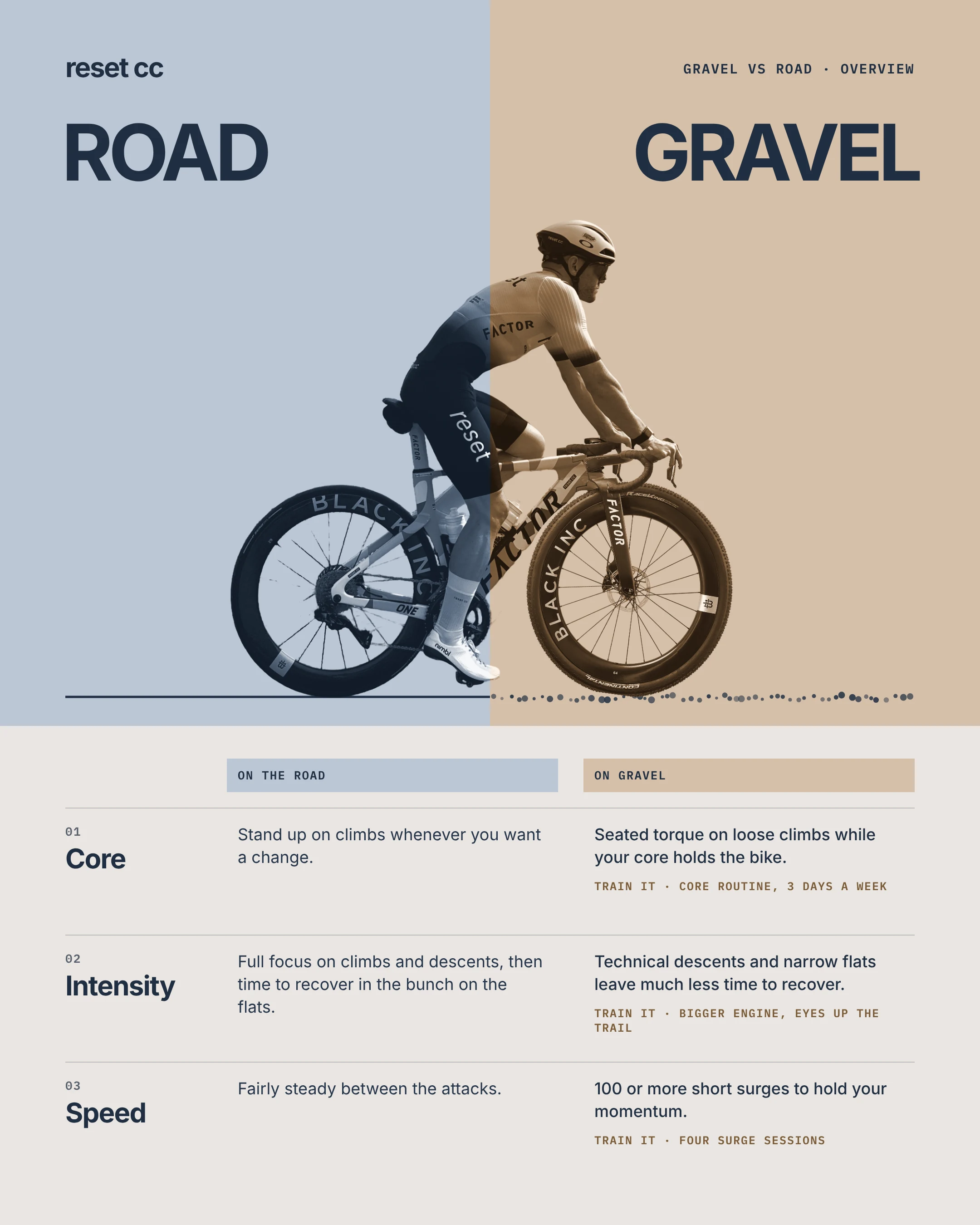
Gravel and road look like the same sport until you race both. There are plenty of differences between them, but in my experience three matter most: gravel asks more of your core, gives you less time to recover, and makes you surge over and over again. Here is what each one feels like from the saddle, and how I prepare riders for it.
Plenty of strong road riders turn up to their first gravel race with the right numbers and still have a hard day. Their threshold power and endurance are fine. What catches them out is that the load shows up in places a road plan doesn’t target. The fitness transfers. The demands around it are different, and they need their own preparation.
Below are the three differences I see as the biggest, each with a simple way to prepare for it. Focus on these three and you will ride gravel better. None of it needs special equipment, and all of it fits around a normal road training week.
1. Gravel demands far more core strength
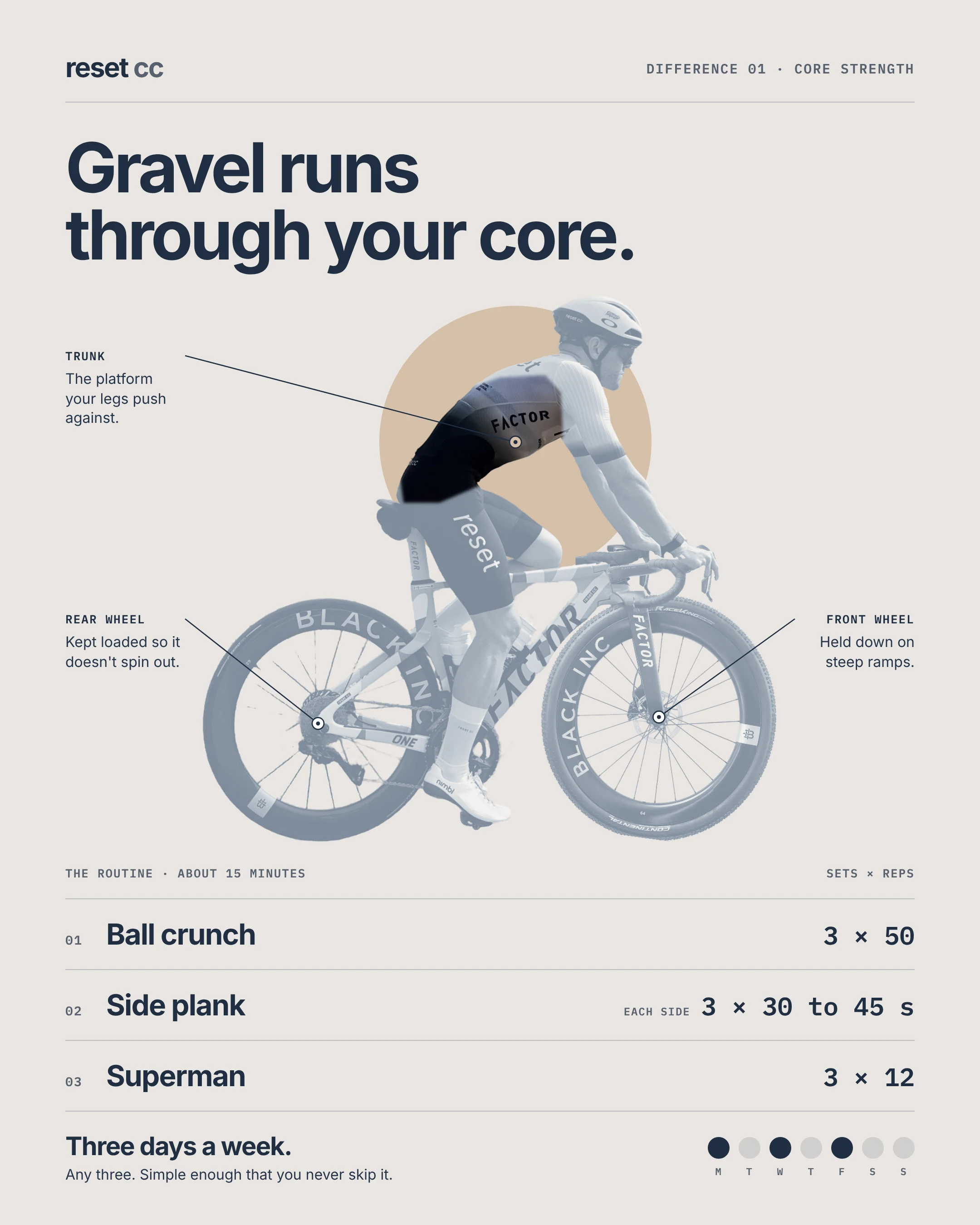
On a road climb you can stand up whenever you want a change of position. On a steep, loose gravel climb you mostly can’t. Stand up and the rear wheel loses traction and spins out, so you stay seated and push big torque through the pedals at low cadence on gradients that would have you out of the saddle on tarmac.
The torque has to come from somewhere stable. Your trunk is the platform your legs push against, and on gravel it has to do that while the bike moves around underneath you. You are holding the front wheel down so it doesn’t lift, keeping weight over the rear so it keeps grip, and steering through ruts and loose stones at the same time. Every one of those jobs runs through your core.
The result is a ride that is more systemically taxing than the same hours on the road. In my experience, the riders who skip core work are the ones who fade late in a gravel race and start making mistakes on the descents.
The fix: a core routine simple enough that you actually do it
The best core routine is the one you will do three days a week for the whole season. I keep mine short on purpose:
Exercise
Sets
Reps or hold
Crunch on a stability ball
3
50
Side plank
3 per side
30 to 45 s hold
Superman
3
12
It takes about 15 minutes and needs nothing but a ball and a floor. Do it three days a week, after a ride or in the evening. If you already have a routine you are consistent with, keep it. The point is to have one so easy to execute that you never skip it.
2. The overall intensity is higher, with less time to recover
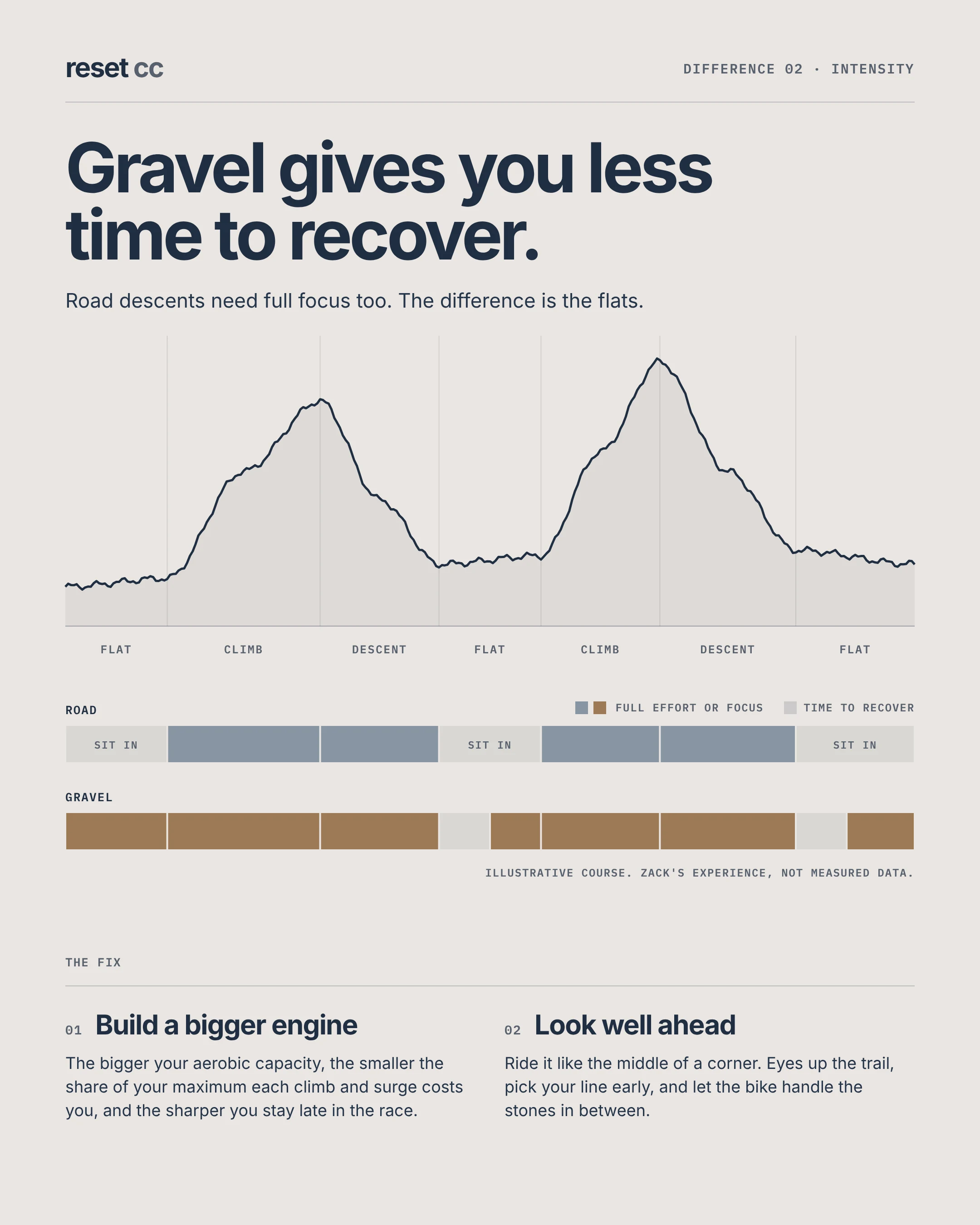
Road racing is hard. You go deep on the climbs, and a fast descent in a bunch needs your full focus. Even when the climbs and descents take everything, you usually get to recover on the flats: you sit in the bunch, out of the wind, and give your body and your mind a break before the next climb.
Gravel gives you far less of that. You still go all out on the climbs, and the descents are technical, on loose surfaces and narrow trails. The big difference is the flats. They can be a narrow, rutted trail that needs all of your attention, so there is much less terrain where you can switch off and recover.
Over a whole race that adds up. Your heart rate and power may look similar to a road race on paper, but with fewer chances to recover, and the concentration it takes to stay upright and on the right line, the total load is higher than a power file shows. Gravel is physically and mentally taxing at the same time, for hours.
The fix, part one: build a bigger engine
The fitter rider is rewarded on gravel. The bigger your aerobic capacity, the lower the fraction of your maximum each climb and each surge costs you. That leaves more in reserve, keeps your overall load down, and makes it easier to stay sharp when the trail gets technical late in the race.
This is ordinary good training: plenty of Z1 volume, Z2 as a harder aerobic session, then tempo, threshold and VO2 work in the right order. Gravel just punishes a small engine more than the road does.
The fix, part two: learn to look ahead
Riding gravel is like being in the middle of a corner all the time. In a corner you look where you want to go, and your body and the bike follow your eyes. On gravel you do that constantly. Lift your eyes off the front wheel, pick your line well up the trail, and let the bike handle the stones in between.
This skill keeps you safe, and it lets you cover ground faster with less effort because you choose good lines early instead of reacting late. Practise it on easy rides on trails you know: keep your eyes up the trail and notice how much smoother the bike feels.
3. Gravel is full of micro-accelerations
A road race has surges, but between them the speed is fairly steady. Gravel never settles. Every corner, rut, sandy patch, short ramp and narrow gap takes speed off you, and every time it does you have to accelerate back up to the speed of the group. Slow to fast, fast to slow, over and over.
Each of those surges is short, usually somewhere between 10 and 30 seconds. Miss one and the gap opens, and on a narrow trail you may not get the chance to close it. In a gravel race you can make 100 or more of these efforts. None of them is long. Repeated for three or four hours, they are what breaks most riders.
The fix: four surge sessions
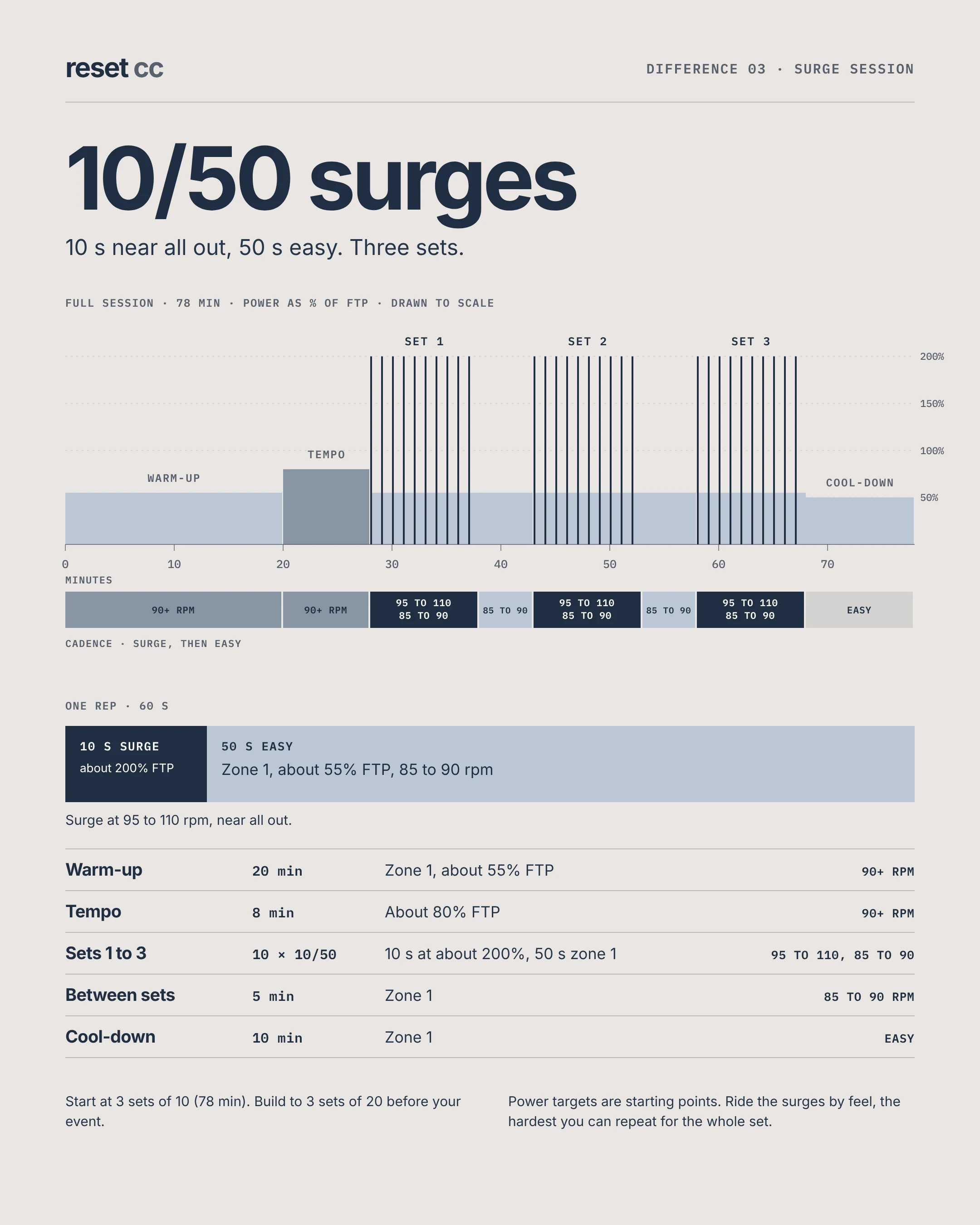
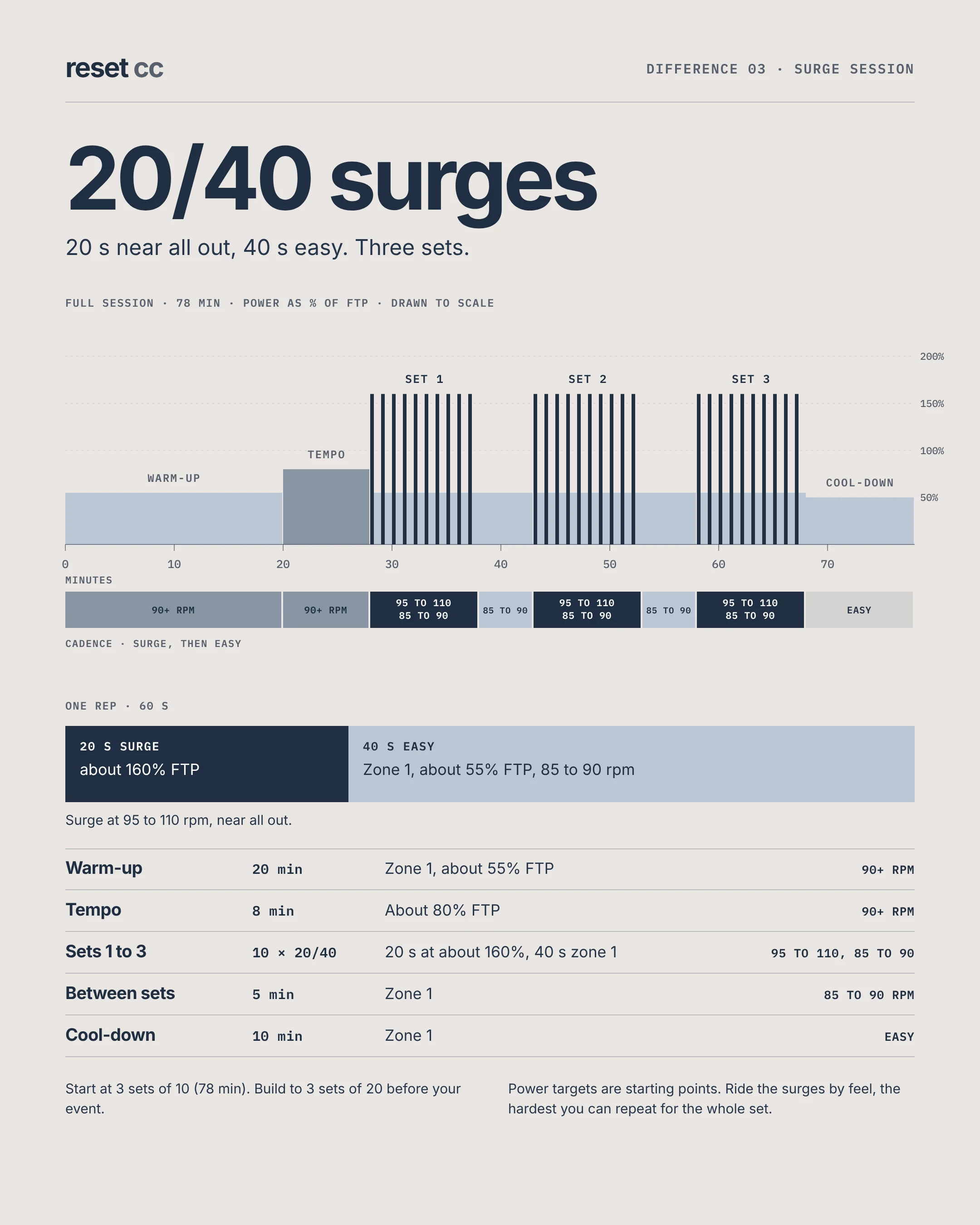
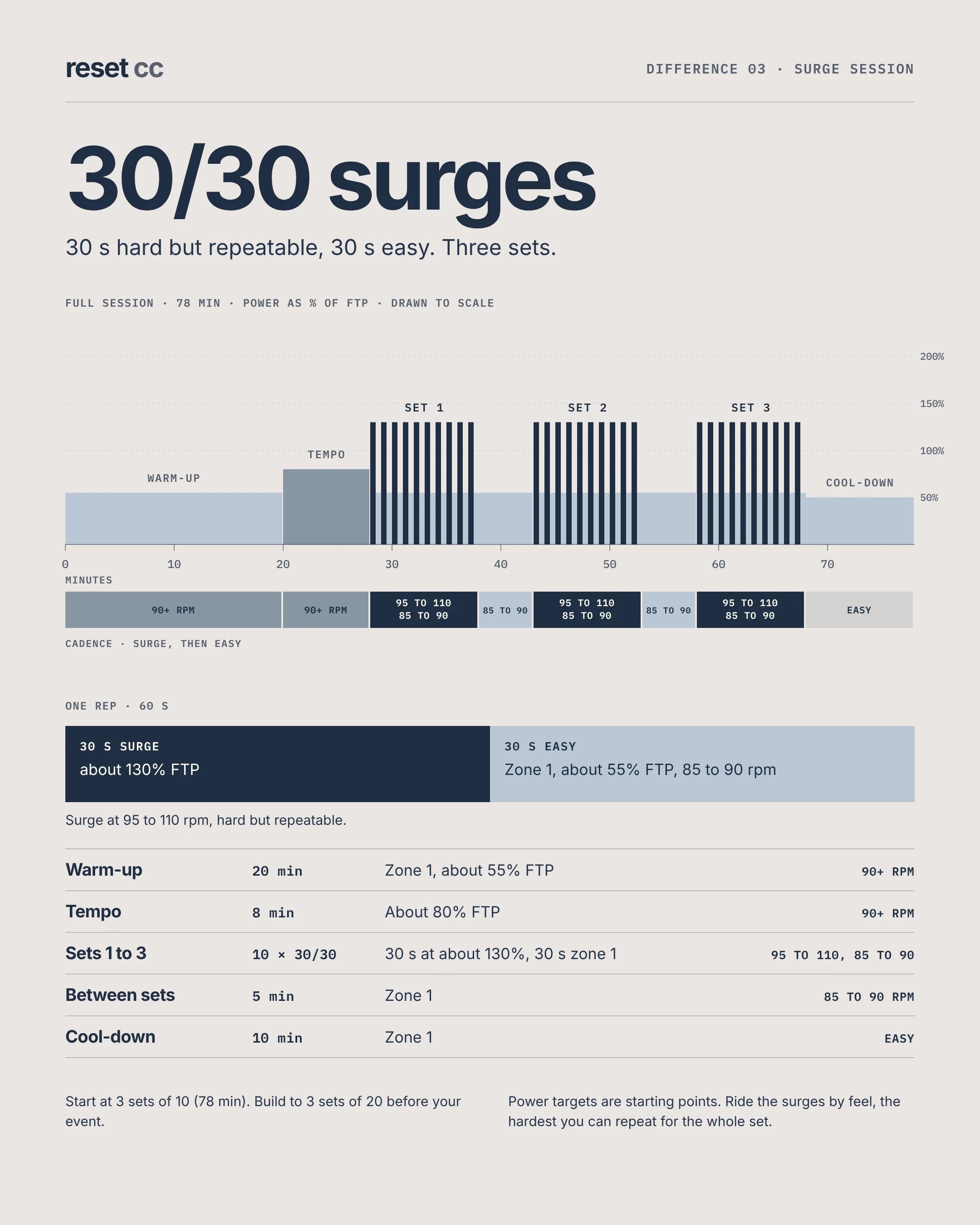
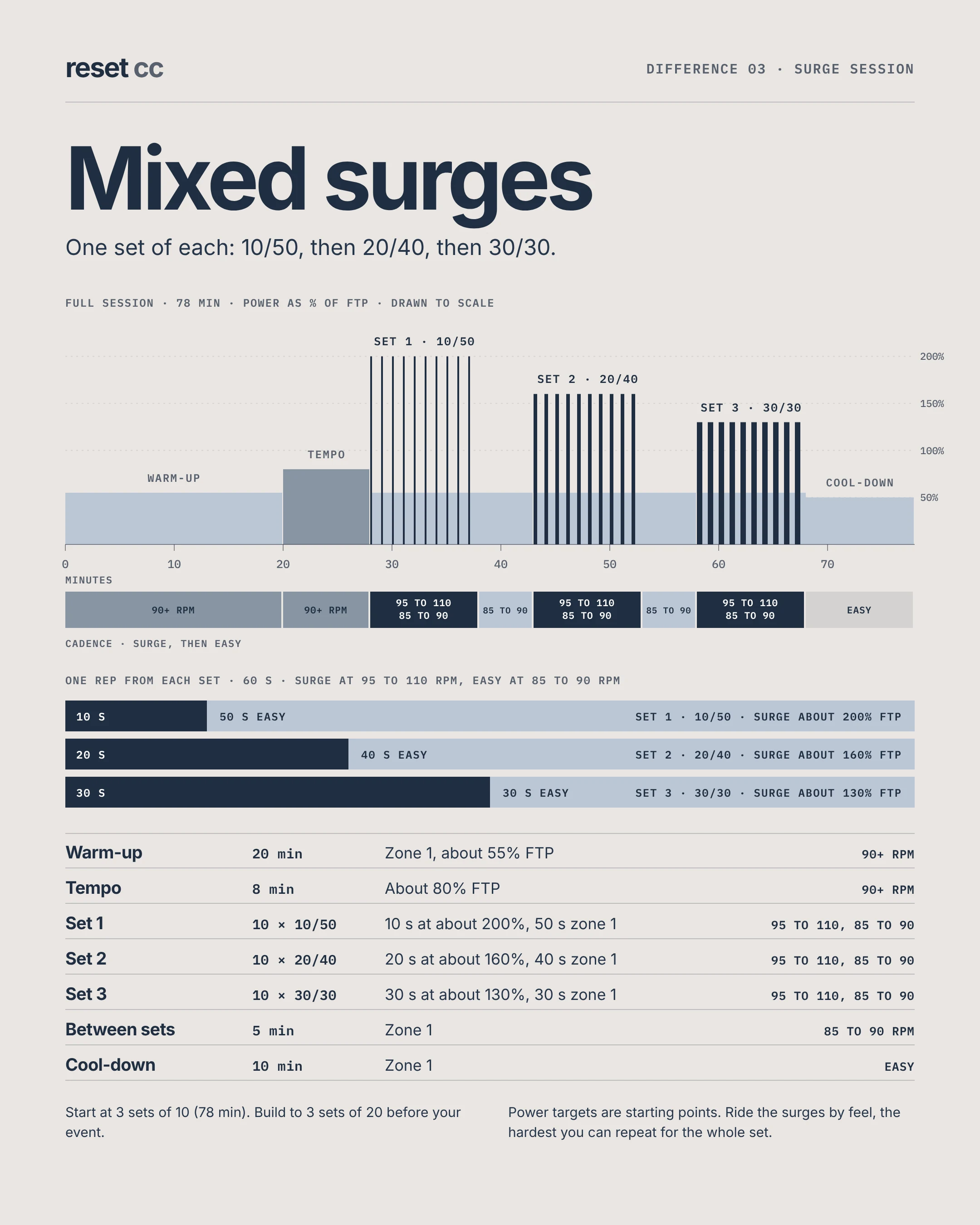
The sessions I use train exactly this: short, aggressive accelerations with an easy lull between them, repeated until the repetition itself becomes the training stimulus. There are three versions. The 10/50 is the sharpest surge with the longest recovery, the 30/30 is the longest surge with the shortest recovery, and the 20/40 sits between them. A fourth, mixed session does one set of each: 10/50 first, then 20/40, then 30/30, so the surges get longer as you tire.
Every session follows the same structure:
20 minutes in zone 1 at 90 rpm or higher
8 minutes of tempo at 90 rpm or higher
Set 1: surge at 95 to 110 rpm, recover in zone 1 at 85 to 90 rpm
5 minutes in zone 1 at 85 to 90 rpm
Set 2
5 minutes in zone 1 at 85 to 90 rpm
Set 3
10 minute cool-down
Session
Surge
Easy
Effort
3 × 10 / 3 × 20
10/50
10 s
50 s
Near all out
78 / 108 min
20/40
20 s
40 s
Near all out
78 / 108 min
30/30
30 s
30 s
Hard but repeatable
78 / 108 min
Mixed
10, 20, 30 s
50, 40, 30 s
One set of each
78 / 108 min
Start at three sets of 10 and build toward three sets of 20 over the weeks before your event. Go as hard as you can while still being able to repeat the effort for the whole set. The lull is as important as the surge: drop right back to zone 1 and keep the legs turning at 85 to 90 rpm, the same way you would roll out of a corner on the trail. Over time this builds the muscular fatigue resistance and durability to keep answering surges late in the race.
If you train with lactate, you will recognise this as repeated lactate production and clearance work. If you don’t, the goal is simple: keep the quality of your surges right to the end of the last set.
Where they fit. These sessions train one part of gravel racing: the surges. A gravel race also has long sustained climbs, steady hours at endurance pace and hard efforts at threshold and VO2, and each of those needs its own training. The surge sessions complement that work, so add them to a complete plan alongside your long rides and your threshold and VO2 intervals.
Download the workouts
All four sessions come in both lengths, three sets of 10 and three sets of 20, ready to load into the apps and devices you already use:
Zwift: put the .zwo file in Documents/Zwift/Workouts/ inside the folder named with your Zwift ID number, then restart Zwift. It appears under Custom Workouts.
TrainingPeaks: in your Workout Library, choose Import Workout and select the .zwo file. Drag it onto your calendar and it syncs to your connected apps and devices.
intervals.icu: import the .zwo or .fit file into your workout library, then add it to your calendar.
Garmin Edge: connect it by USB and copy the .fit file into the Garmin/NewFiles folder. It appears under Training, then Workouts.
The power targets in the files are starting points as a percentage of FTP: about 55% in zone 1, 80% at tempo, and surges at about 200% for the 10/50, 160% for the 20/40 and 130% for the 30/30, and the mixed session uses all three. Ride the surges by feel. On a smart trainer, resistance or slope mode handles short surges better than ERG.
Seated torque on steep, loose climbs while controlling the bike
Ball crunches, side planks and supermans, 3 days a week
Higher overall intensity
Full focus on climbs, descents and flats, with less time to recover
A bigger aerobic engine, and the habit of looking well ahead
Micro-accelerations
100 or more short surges to hold momentum
10/50, 20/40, 30/30 and mixed surge sessions, 3 sets of 10 to 20
Gravel has plenty of other demands, but in my experience these three make the biggest difference. None of this replaces your road training. Keep the aerobic base and the structured intervals, and add the three pieces gravel asks for.
Free tool · 2027 Season Map
Where should your 2027 start?
Answer nine questions. Get the team camp to target, your odds at every Worlds qualifier and what each course will ask of you.
Your best qualifiersRanked for you by your odds, the trip from home and the size of your field
Your odds at each oneFrom your FTP, weight, durability and race skills, against the real qualifying times in your age group
Your season, week by weekBase, build, race and taper, with the decisive climb of every course and the power it will take from you
Racing gravel?Pick Gravel and your map adds the UCI Gravel World Series qualifiers announced so far for Gravel Worlds in Châtel, 26 to 27 August 2027. We email you as more are added.
Pick all that apply. All three are in Haute-Savoie in the same week of August 2027. A road qualification also counts for the time trial, and gravel has its own qualifiers.
Road raceTue 24 Aug
Time trialSun 22 Aug
GravelChâtel, 26 to 27 Aug
Next
Example map · Men 50-54 · from Barcelona
Your best qualifierThe MillarsSun 14 Mar 2027 · Castellón, Spain
Your odds
Likely
The trip
About 3 h by car
Decisive climb
Salto del Caballo, 8.8 km at about 5%
OctMillarsWorlds
+ your odds at every other qualifier
Gravel vs road cycling: common questions
Is gravel riding harder than road cycling?
Both are hard. In my experience, for the same time and average power, gravel usually feels harder: the terrain asks more of your core, there is less time to recover, and the speed changes far more often, so the total load is higher than the power numbers suggest.
Can road fitness transfer to gravel?
Yes. Aerobic fitness is the foundation of both, and a big engine helps even more on gravel. What doesn’t transfer automatically is core strength, bike handling and the ability to repeat short surges, which is why those need dedicated training.
How often should I do core work for gravel?
Three days a week, with a routine short enough that you never skip it. Mine takes about 15 minutes.
What intervals should I do for gravel racing?
More than one kind. A gravel race mixes long sustained climbs, efforts at threshold and VO2, hours of endurance and repeated short surges, and a good plan trains all of them. The surge sessions in this article cover the surges: 10/50, 20/40, 30/30 and a mixed session, in three sets of 10 to 20. Do them alongside your threshold and VO2 intervals and your long rides. All four are free to download above for Zwift, TrainingPeaks, intervals.icu and Garmin.
Coaching and membership · 2027 season
Train for your next gravel race with reset cc
If you have a gravel race on your calendar, this is the kind of preparation we build into every reset cc plan. Your coach fits it into your week around the races you care about and updates the plan every week.
Team membership · 2027 season
Race the 2027 season with the team
Three levels, from one team camp to the whole season on the road to Worlds. Every level includes:
✓Your own reset cc coach
✓Strength and nutrition
✓Two calls a month
✓Your roadmap to Worlds
✓The Girona block
✓The full custom team kit
+Team Rider and Full Season add the team bike and more race camps
Zack Morris is the founder of Reset CC. Silver medalist, M35-39 time trial, 2026 UCI Gran Fondo World Championships. National champion, elite and masters. He built and ran Team EF Coaching for five years and is based in Girona, Spain.