The cycling off-season: what to focus on before next season
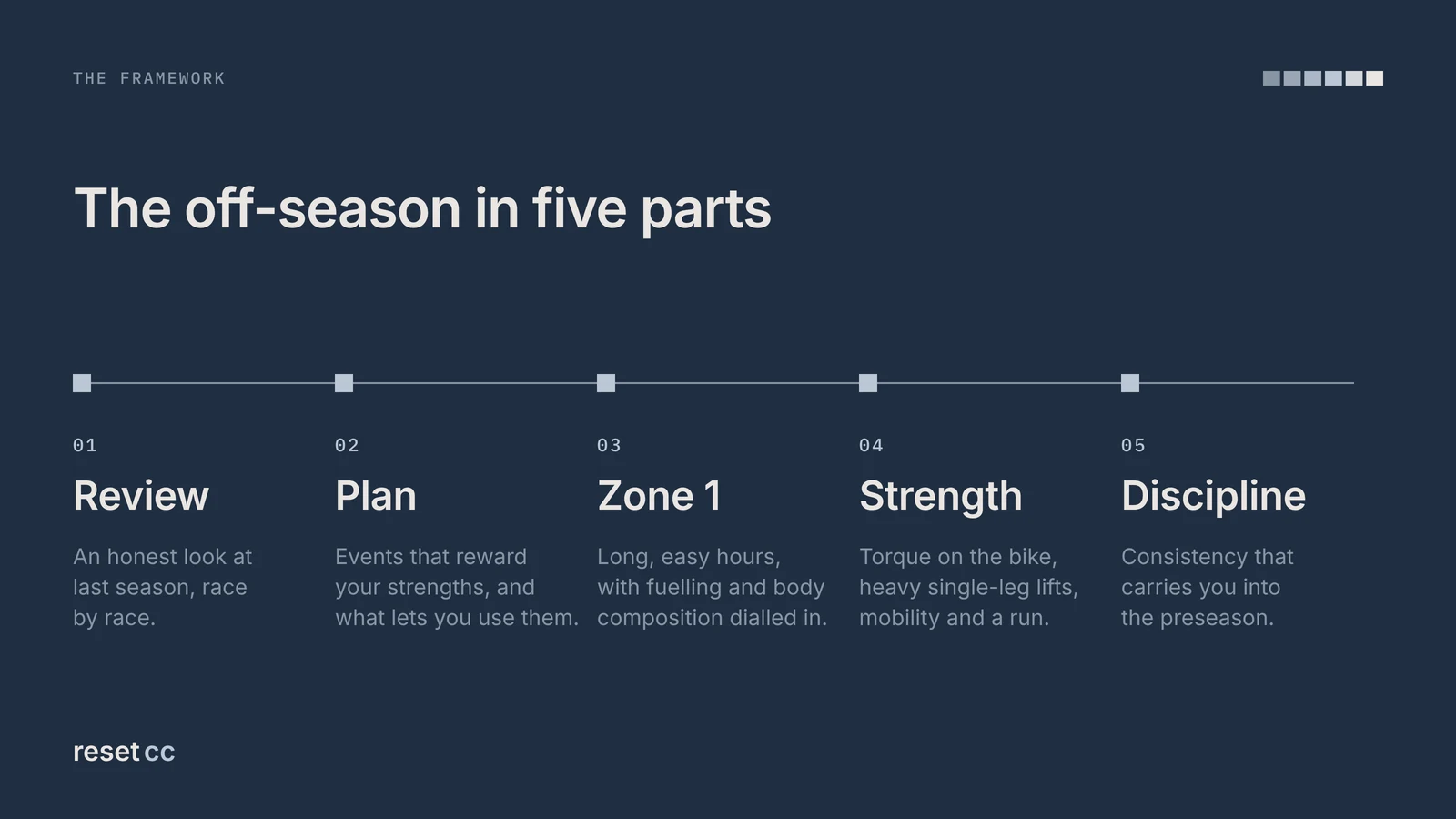
The off-season is when you recalibrate. If you race a northern-hemisphere calendar, it starts now. A good off-season sets up your preseason, and a good preseason sets up your racing. This is what I have our athletes at reset cc focus on, in order.
The short version
Review. Have an honest conversation with yourself about last season.
Plan. Use that review as the roadmap: choose events that reward your strengths, and build the abilities that let you use them.
Zone 1. Ride long and easy, with most of your endurance riding in zone 1. Match your fuelling to the work, and use the lower intensity to make any body composition changes you need.
Strength. Build force on the bike with torque work and in the gym with heavy lifting, and move outside the single plane of the bike.
Discipline. Stay consistent so the off-season carries into your preseason.
If you want all of this laid out session by session, The Reset Off-Season is our 12-week plan built on these principles.
1. Start with an honest season review
The most useful thing you can do this month is sit down and have an honest conversation with yourself about the season you just had. Write the answers down. A review only helps if it is specific.
How did the season go overall?
What went well, and why did it go well?
What did not go well, and why?
How did you feel in each race you did?
How did you feel in each type of race: road races, time trials, gran fondos, hilly courses, flat courses, long events and short ones?
Did you race enough variety to learn which formats suit you?
Which result would have been entirely different if you had been a little better at one thing? A stronger three-minute effort when the race split, better positioning before the climb, or better fuelling in the last hour.
When riders answer these honestly, the same few findings come up again and again.
Race selection. The events did not suit the rider’s strengths, or there were too few of them to learn anything.
Travel. Arriving late, tired or poorly fuelled cost more than any gap in fitness.
A missing ability. The three-minute or five-minute power was not there when the race split.
Finishing the performance. Strong for most of the event, then nothing left for the end.
Event length. Ultra-distance events chosen without the time or commitment to train for them. Shorter events may be the better fit for your life right now.
2. Turn the review into your roadmap
The off-season is the season of dreaming. Once riders settle back into a routine, they start building a picture of who they want to be next year. That picture matters, and it is far more useful when it sits on top of an honest review. The review becomes the roadmap.
Start with your assets. What are you naturally good at? Then answer three questions.
Which events reward those assets?
Where are those events, and how will you get to them in good shape?
What do you need to improve so you can use your strength on race day?
The third question is the one most riders skip. They know what they are good at and keep training it, while the abilities that put them in a position to use it stay neglected.
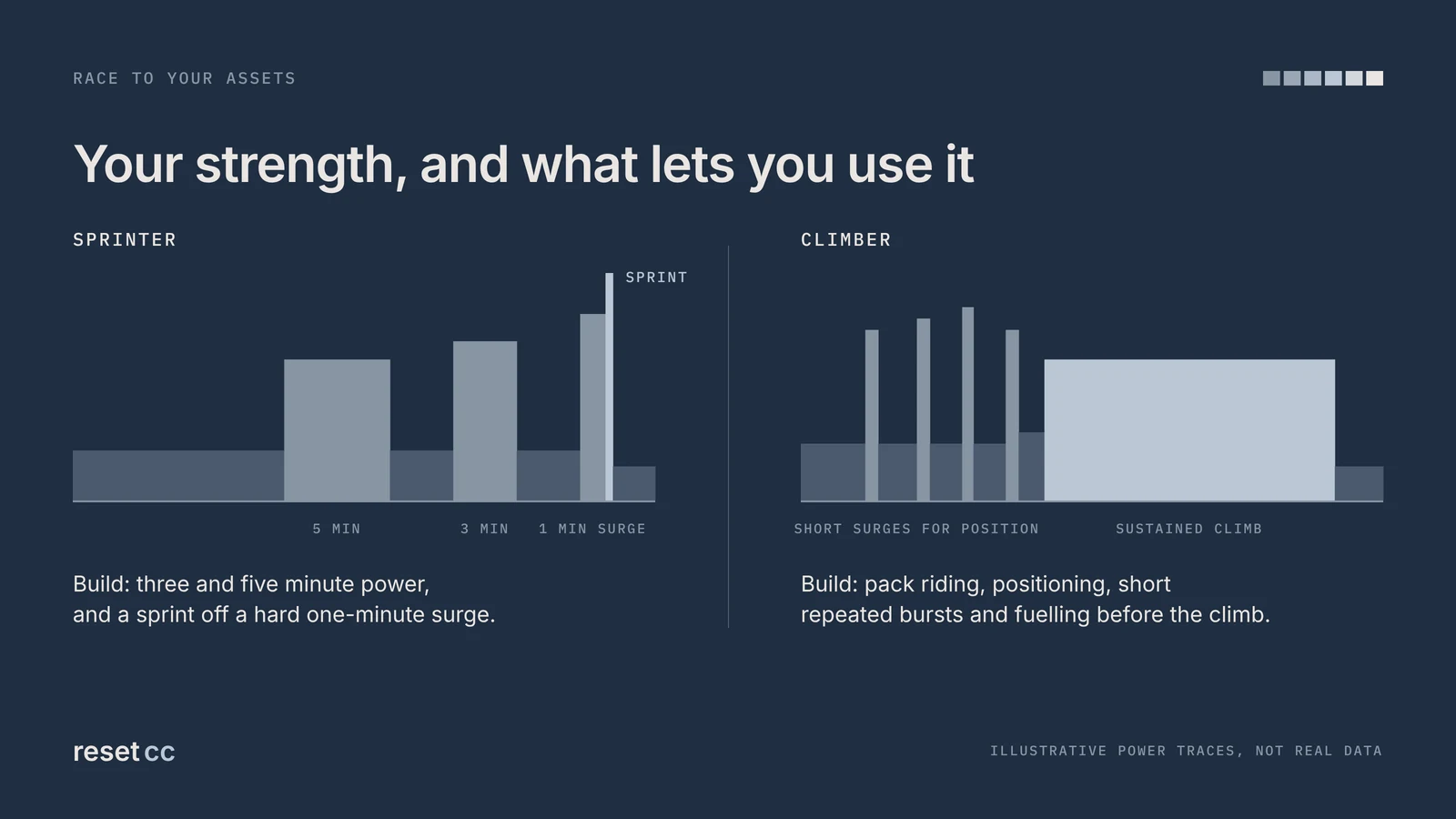
A sprinter has to survive the three-minute and five-minute efforts that split the race, then sprint off the top of a big one-minute surge. If those efforts empty the legs, the sprint never happens. For a sprinter, those durations are the work.
A climber is usually strong over long, sustained efforts. The hard part is reaching the bottom of the climb in position without a lot of damage in the legs. For many climbers the work is pack riding and positioning, or the short repeated bursts that drain them before the climb starts. For some it is fuelling.
3. Make zone 1 the foundation of your base
Once the review is done and the plan is set, it is time to get stuck into base training. For most riders the off-season means stepping back from intensity and embracing zone 1.
At reset cc our zones are anchored to lactate. Zone 1 is genuinely easy riding. Zone 2 sits just below the first lactate threshold, and we count it as a harder session. Tempo, threshold and VO2 max sit above that.
Last season we moved most of our athletes’ endurance riding into zone 1, and the growth we saw across the group was the best we have had.
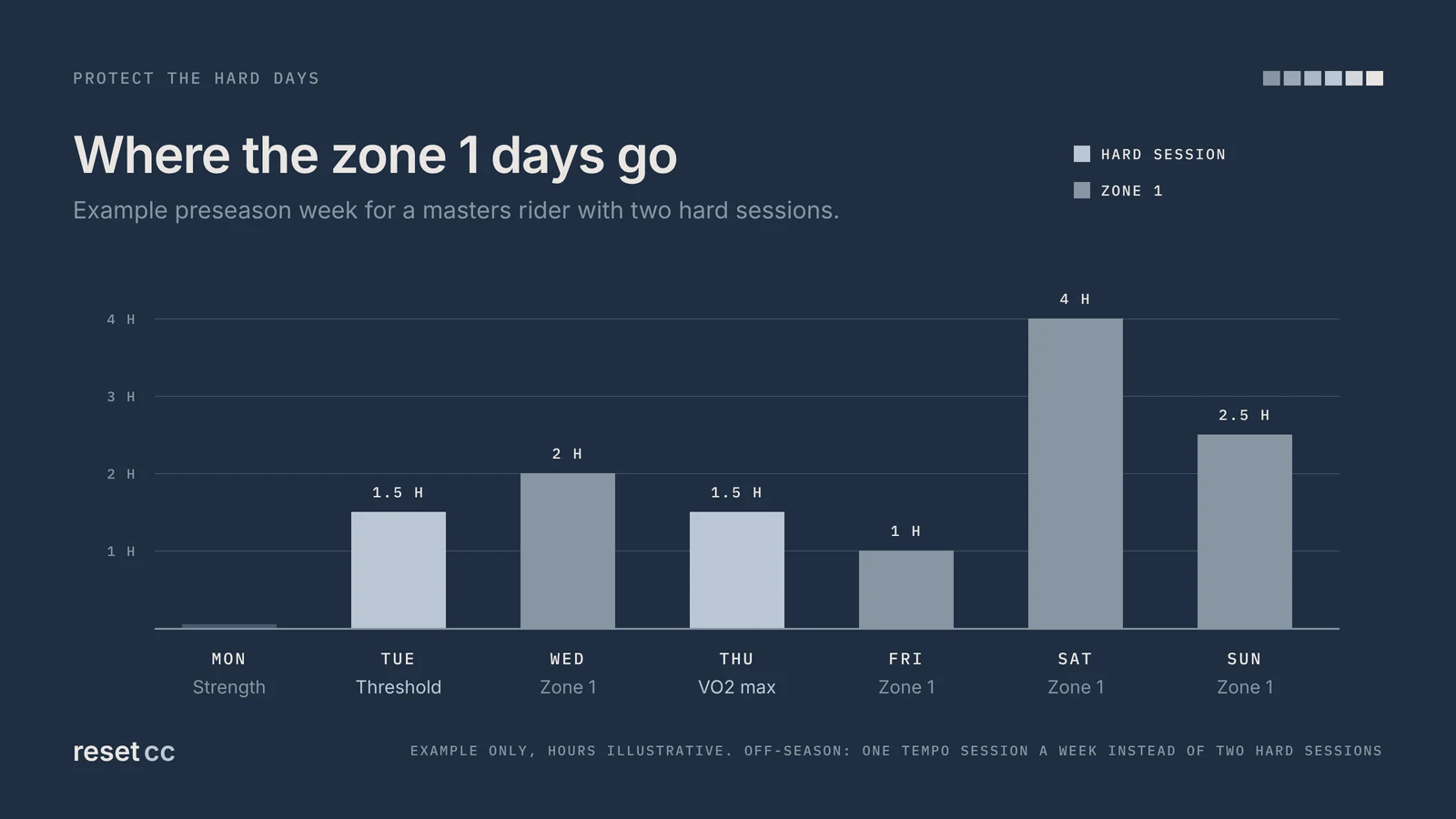
The reasoning is simple. In my experience coaching masters riders, most can absorb about two hard sessions a week. In a big week, with everything else in life under control, some can fit in a third. Those sessions drive the improvement, so the days in between should protect them. Zone 2 and tempo riding on those days adds fatigue and takes away from how well the rider executes the next hard session. When we filled the days between hard sessions with zone 1, we got better high-intensity sessions out of our athletes across the group.
That is a coaching observation from our own athletes. It did not come from a controlled study. The research supports the general shape. Endurance athletes who do most of their training below the first threshold, with a smaller share at high intensity, improve, and meta-analyses find that polarized and pyramidal versions of that pattern produce similar time-trial gains. (Evidence B) The research does not split low-intensity riding into our zone 1 and zone 2. Putting most of it in zone 1 is our coaching decision, based on what we have seen.
Zone 1 is easy, and that is exactly why it is hard to do. Most riders do not have the discipline to ride that easy, especially in a group. Building that discipline in the off-season is a skill that pays off all year.
Match your fuelling to the work
Zone 1 also gives you room to work on how you fuel. Long easy rides are where we use lower carbohydrate intakes. The one tempo session a week in the off-season is where we fuel fully. The goal is a clear contrast in intensity and in fuelling.
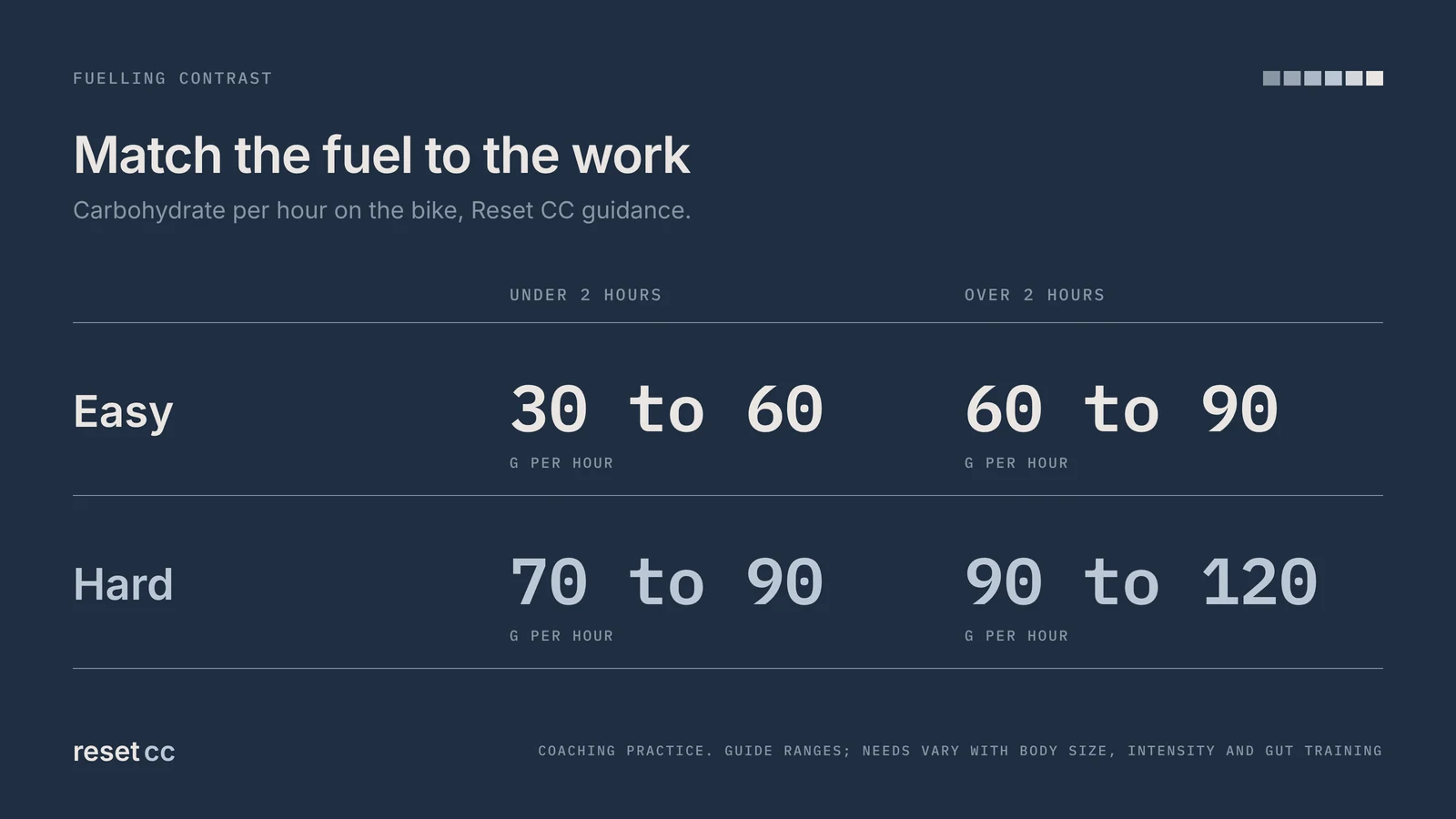
Our on-bike guidance at reset cc: on easy rides, 30 to 60 g of carbohydrate per hour under two hours and 60 to 90 g over two hours. On hard rides, about 70 to 90 g per hour under two hours and 90 to 120 g over two hours.
As you move into the preseason and add threshold and VO2 max sessions between zone 1 days, the same principle carries through: lower on easy days, high on hard days. In my experience, riders who have built this contrast in the off-season get more out of their tempo, threshold and VO2 max sessions.
Be clear on what the research shows. Training some sessions with lower carbohydrate availability increases cell signalling and markers of muscle adaptation in most studies, but those changes improved performance in only about a third of the 11 studies in one review that measured it. A 2021 meta-analysis of nine studies in highly trained endurance athletes found no overall performance effect from periodized carbohydrate restriction. (Evidence B) So we use it to match fuel to the work. We do not cut carbohydrate during hard sessions, and we never run a deficit on rest days.
4. Use the lower-intensity months for body composition
Most riders take a break from their diet when the season ends, and they should. After months of fuelling around races and watching every gram, a short break is part of recalibrating.
Once you are back in a routine, the off-season and the preseason are the best time of year to make any body composition changes you need. There are no races to peak for, and the long, easier days give you room to work with. The goal is to lose body fat while still recovering from training, day in and day out. Leave it until spring and you are trying to lose weight while threshold work, VO2 max sessions and racing all compete for the same food.
The output is the budget
At reset cc, what you eat each day is set by what you spent. The day’s output is the budget.
Three parts of the budget stay fairly constant from day to day.
Protein. 1.2 to 2 g per kg of body weight a day, adjusted a little for how much you are training.
Fat. About 55 to 65 g a day.
Carbohydrate. Enough to refill what the day’s training used. Your glycogen stores in muscle and liver are finite, at roughly 500 g in an average adult and up to about 800 g in a large, well-trained rider after carbohydrate loading (estimate). That sets a ceiling on how much carbohydrate you need off the bike to be fully recovered for the next session.
What changes from day to day is your expenditure, and your power meter measures it. Work on the bike is measured in kilojoules, and because the body converts food to work at roughly 20 to 25% efficiency, the kJ on your head unit come out close to the kcal you burned on the ride (estimate).
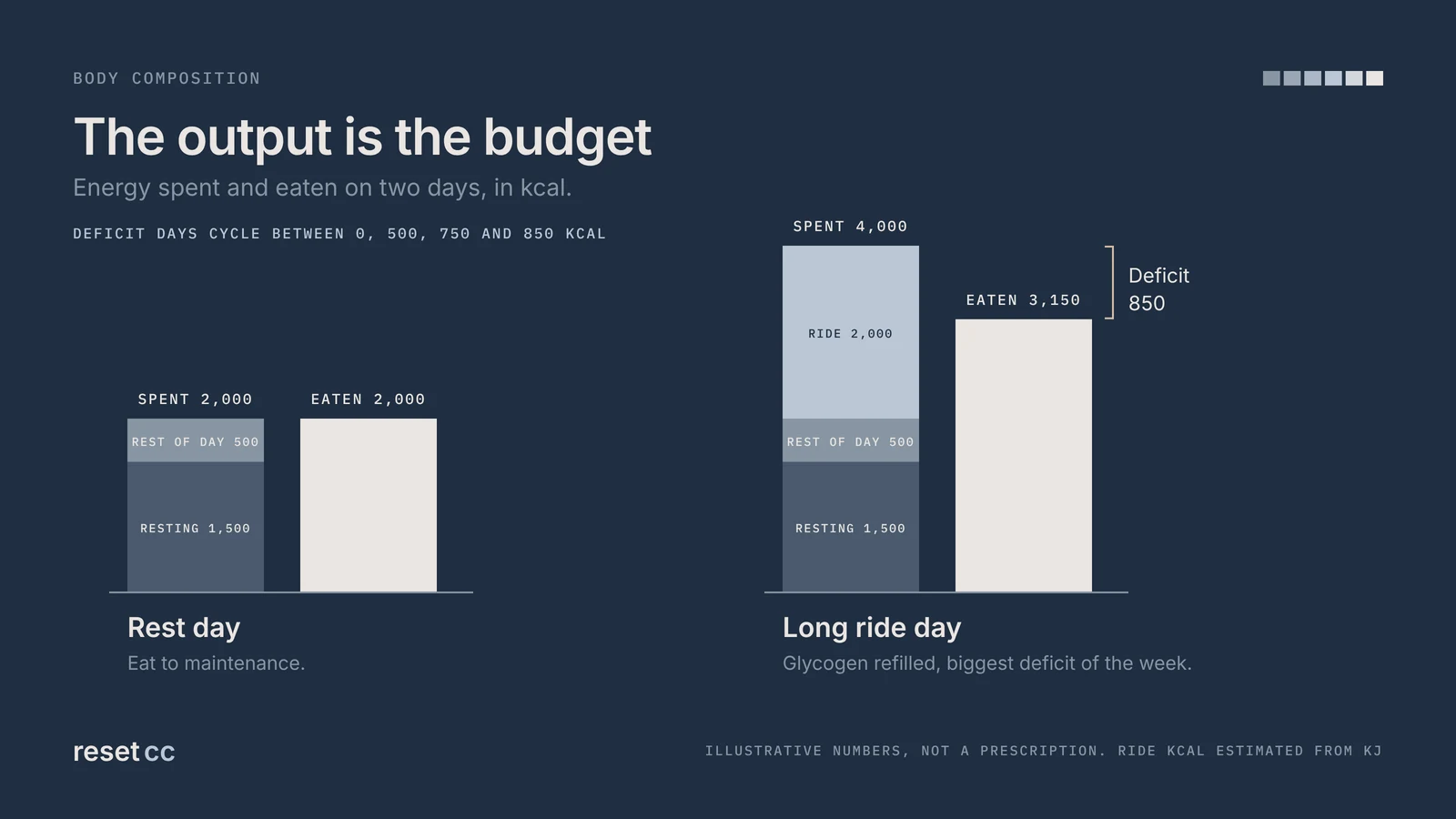
On a long ride you can burn 2,000 kcal. Add a resting metabolic rate of around 1,500 kcal and the rest of your day, and you have spent around 4,000 kcal. You could eat more than 3,000 kcal across the day, on and off the bike, refill your glycogen, feel full and still run your biggest deficit of the week. Long easy days, and long hard days, create the biggest budget, so that is where the larger deficits go.
Rest days are the opposite. Output is low, so the budget shrinks, and on rest days we make sure the athlete does not run a deficit. Eating to maintenance on rest days supports recovery, helps you adapt to the training you have done, and stops you feeling like you are starving.
Cycle the deficit, and keep it moderate
Most riders who run into energy problems got there by doing something too extreme. We cycle deficit days of 0, 500, 750 and 850 kcal, matched to the day’s training, with the larger deficits on the days with the most output. They do not come in a fixed order. A 750 kcal day can be followed by a rest day at zero, then a 500 kcal day, another zero and then an 850 kcal day. Recovery comes first, and the deficit only uses the budget the training has created.
This is not something to do all year. We run it in blocks, two to three times a year, until the weight is off. After that the job is to hold it there, feel good and drive power.
This is how every reset cc athlete manages body composition, and it is how I prepared for my silver medal in the M35-39 time trial at the 2026 UCI Gran Fondo World Championships. We have seen it work well for athletes who can be disciplined about it. It is our method, built from coaching practice, and it has not been tested as a whole in a controlled trial. (Coaching practice) You need to make your own decisions about whether it suits you.
Why we are comfortable with it for most masters riders: the problems you read about tend to show up in athletes trying to cut weight while forcing adaptations at the very highest outputs, often under pressure to get results. A rider carrying 20 or 30 pounds more than they need, training at amateur volumes, is in a different position. Their outputs are lower, and so is what they need to replenish each day. That is our coaching view. The research has not tested this question directly. Getting leaner also pays back on the bike: every kilo of fat you lose raises your watts per kilo and your VO2 max per kilo, even before your fitness changes.
It only works if you know both sides of the budget, so this is the time to track your intake and stay on top of it. Your power meter already tracks the output.
Keep lifting while you do it. In a randomized trial of 24 elite athletes who were strength training four times a week, a target of 0.7% of body weight lost per week increased lean mass by about 2%, while a target of 1.4% per week left lean mass unchanged. The athletes were young and were not cyclists, so treat the numbers as a guide. (Evidence B)
Eating too little for the training you do still has real costs. The International Olympic Committee’s 2023 consensus statement on Relative Energy Deficiency in Sport (REDs) links low energy availability to problems with hormones, bone, immunity, mood and performance, in men and in women. (Evidence B) If you notice lasting fatigue, falling performance, frequent illness or injury, or changes in your periods or libido, eat more and see a doctor or a sports dietitian. If you have a history of disordered eating, do not track your food on your own. Work with a professional instead.
5. Build torque, and the technique to use it
The off-season is also the time to work on how you apply force to the pedals. At reset cc that starts with torque.
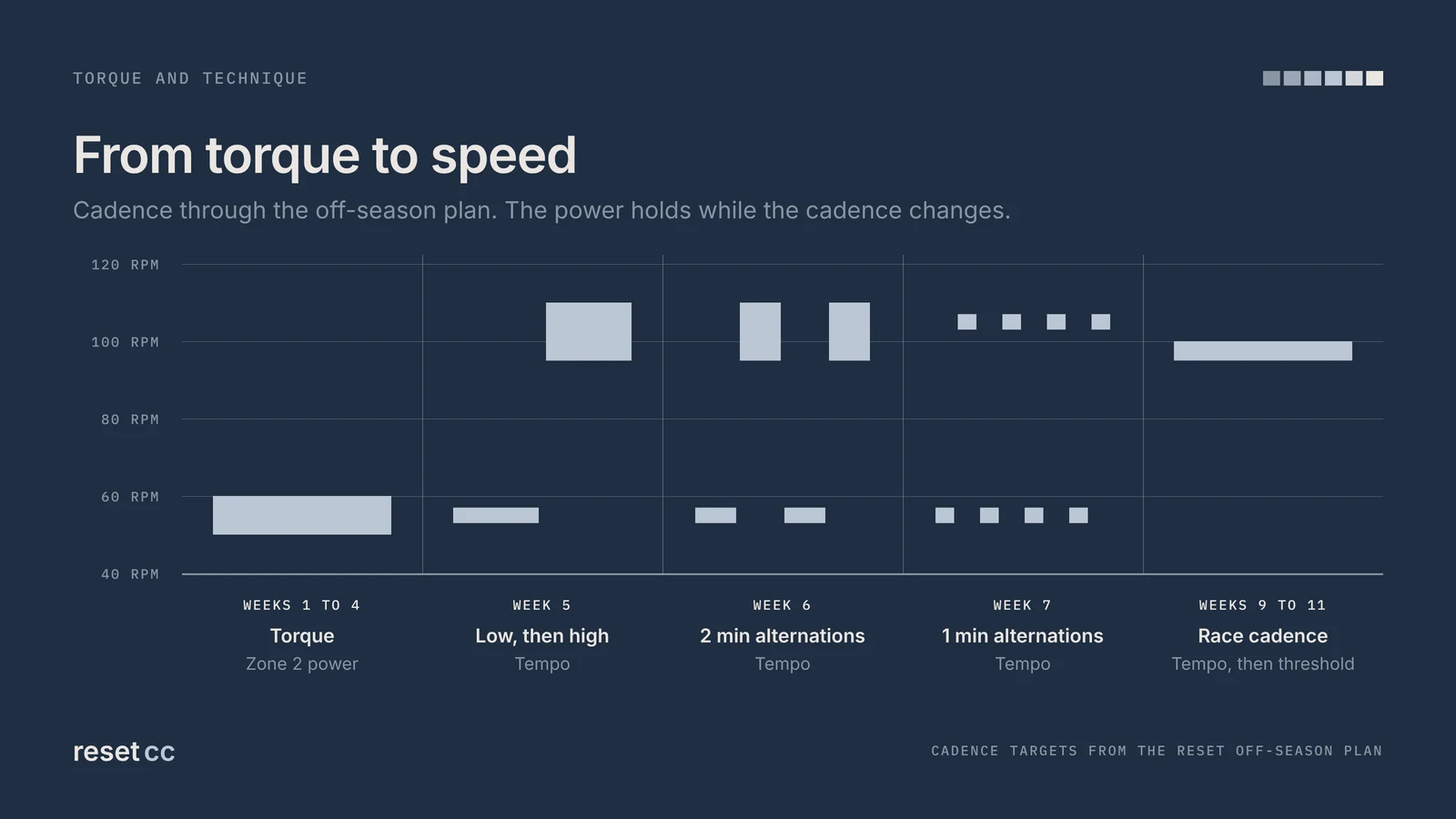
A torque effort is a seated block at low cadence and aerobic power: 50 to 60 rpm at zone 2 power to begin with, then at tempo. The power stays moderate. What changes is how much force goes into every pedal stroke, and how long each stroke takes.
That slower, heavier stroke is why we use torque work for technique. At 55 rpm there is nowhere to hide. A rider who stamps on the downstroke, rocks the upper body or shifts around on the saddle feels it straight away. We use these sessions to teach riders to stay still on the bike, keep the upper body quiet and apply force smoothly through the whole stroke.
Then we teach the legs to carry that force at speed. Torque to speed holds the same power while the cadence moves: from 55 rpm up to 95 to 110 rpm within an effort, then in alternations, and finally tempo and threshold at race cadence. The aim is a rider who can hold power across the whole cadence range they race at.
In my experience this is where riders find efficiency on the bike: a smoother stroke, less wasted movement, and power that holds when the cadence changes. (Coaching practice) Be clear on what the research shows, though. In a 12-week trial in well-trained veteran cyclists aged about 47, adding intervals at 40 rpm and moderate intensity did not change gross efficiency or performance. That is lower than the cadence we use. In a small 4-week trial, threshold intervals at 60 rpm improved uphill time-trial power by about 4%. (Evidence C) The evidence for efficiency gains is stronger for heavy strength training, which is why torque work and the gym sit together in our off-season.
Ride every torque effort seated, keep the power at the target, and stop if you feel sharp knee pain. If you have a history of knee problems, start at the top of the cadence range.
Phase 1 of The Reset Off-Season is built around this: four weeks of torque efforts that build from 4 by 6 minutes to 5 by 8 minutes before the cadence starts to move in phase 2.
6. Lift heavy in the off-season
Some coaches keep strength training going all year. Others build it in blocks leading into the season. At reset cc, real strength training lives in the off-season and the preseason. Through the race season we do maintenance work, mobility and some explosive work, but no traditional heavy lifting, and I pull heavy strength work at least two weeks before a race. (Coaching practice)
Our approach is single-leg movements that make each side work and stabilise on its own, in low rep ranges of about 4 to 6, with no spinal loading. That means no back squats, front squats, deadlifts or trap-bar deadlifts. Goblet squats are fine.
In a 2025 meta-analysis of 17 studies with 262 cyclists, adding heavy strength training to cycling improved cycling performance (effect size 0.46) and cycling efficiency (effect size 0.35), with no change in VO2 max. The authors rated the certainty of the evidence as low, and most trials were small. (Evidence B) Choosing single-leg work over two-leg lifts is a coaching decision for joint and back tolerance. It has not been shown to transfer better to the bike.
7. Move outside the single plane of the bike
Cycling is linear. We move in one plane, seated and supported, for hours at a time, and we rarely leave it. I believe that holds back a lot of riders’ development. The off-season is the time to work on mobility, add some cross-training and put a weekly run in.
There is a bone health reason too. A systematic review of 31 studies found that adult road cyclists in regular training tend to have low bone mineral density in key regions such as the lumbar spine, and that combining cycling with other sports may reduce this. (Evidence C) If you have not run in years, start with short, easy runs and build from there.
8. Stay disciplined and let the blocks stack
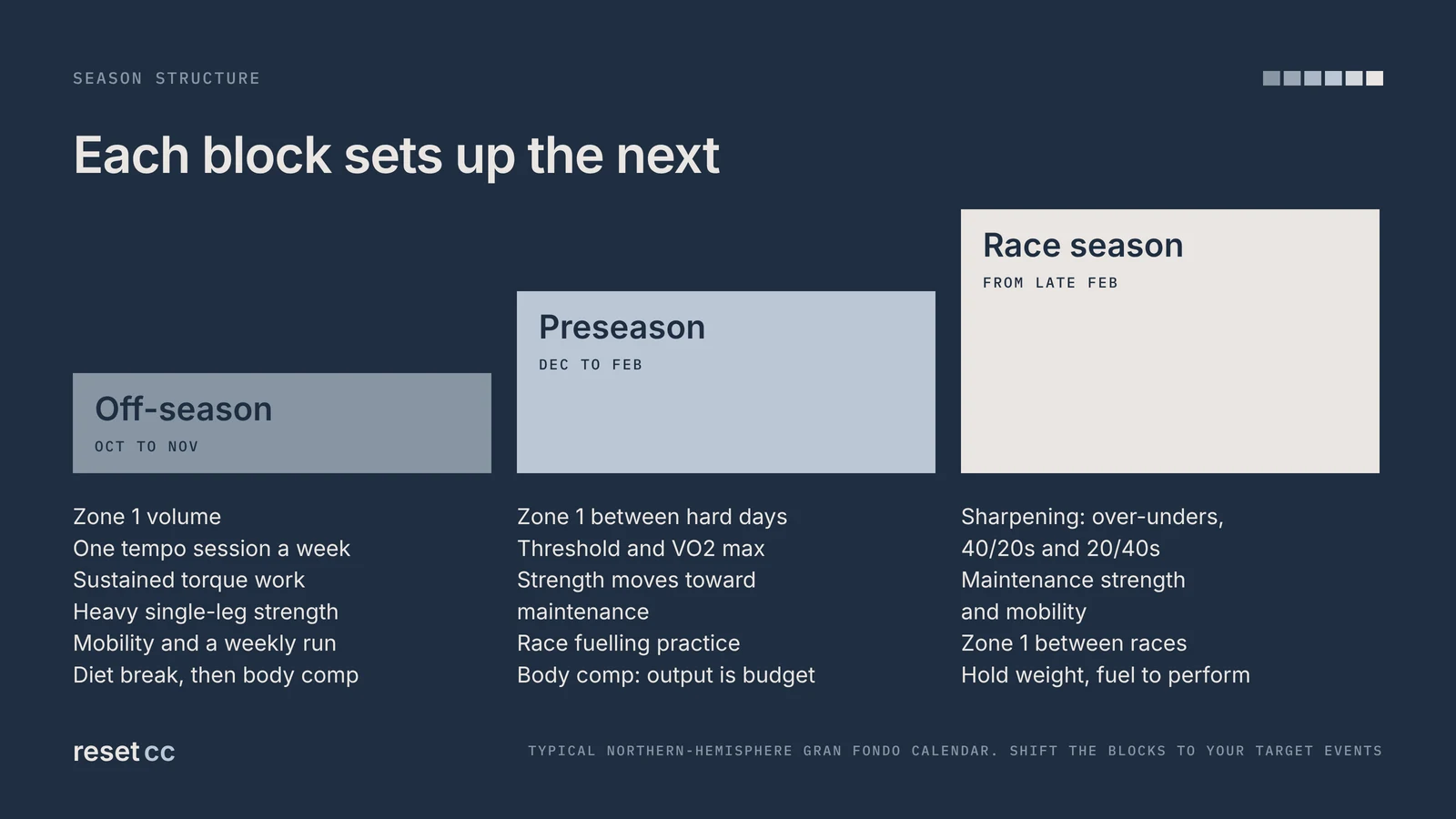
Look at your year as blocks that stack on top of each other. The off-season sets up the preseason, and the preseason sets up the race season. No single part of the year produces a big performance on its own. When the blocks work together, you can race at a high level all season, and it starts now.
The off-season is the hardest block to stay disciplined in. The easy rides feel too easy, the gym is unfamiliar and the first race is months away. That is why the review and the plan come first. A clear picture of next season is what keeps you riding easy on the days you should, lifting when you would rather not, and showing up week after week.
Frequently asked questions
When is the cycling off-season?
For riders racing a northern-hemisphere calendar, the off-season usually runs through October and November. December and January become the preseason, and the race season starts from late February into April. The right dates depend on when your last race was and when your first target event is.
What is zone 1 in cycling?
At reset cc, zone 1 is our easiest training zone. It sits below zone 2, which itself sits just below the first lactate threshold. Zone 1 adds aerobic volume while leaving you fresh for hard sessions. Zone systems differ between coaches, so check how your own zones are anchored before comparing numbers.
Should cyclists do intervals in the off-season?
We keep intensity low in the off-season. Most of our riders do one tempo session a week, then add threshold and VO2 max work in the preseason, with zone 1 riding between the hard days.
Does torque training improve cycling efficiency?
The research is mixed. In well-trained veteran cyclists, 12 weeks of intervals at 40 rpm did not change gross efficiency, while a small trial of threshold intervals at 60 rpm improved uphill time-trial power. At reset cc we use seated torque work at 50 to 60 rpm to teach technique and build force, then carry that force to race cadence. That is coaching practice, and we pair it with heavy strength training, which has better evidence for improving cycling efficiency.
Should cyclists strength train in the off-season?
Yes. Meta-analyses of trained cyclists show heavy strength training added to normal riding improves cycling performance and efficiency without reducing VO2 max, although the certainty of the evidence is low. We run heavy, single-leg strength work in the off-season and preseason, and switch to maintenance and mobility during the race season.
Is the off-season a good time to lose weight?
For most riders, yes. There are no races to peak for, and the long days give you room to work with. At reset cc the day’s output is the budget: protein and fat stay roughly constant, carbohydrate refills what training used, and we cycle deficit days of 0, 500, 750 and 850 kcal, with the larger deficits on the days with the most output. Rest days are eaten to maintenance, and we run it in blocks two to three times a year rather than all year. Keep strength training, and see a doctor if you notice lasting fatigue, frequent illness or falling performance.
Should I ride with low carbohydrate in the off-season?
We fuel long easy rides with less carbohydrate and fuel hard sessions fully. Research shows that training with lower carbohydrate availability increases markers of muscle adaptation, but it has not been shown to improve performance on its own, so it should never come at the cost of fuelling your hard sessions.
Sources
Evidence grades: A strong, B good, C limited, D coaching practice with no direct evidence.
Rosenblat MA et al. Training intensity distribution and VO2 max and time-trial performance: network meta-analysis of individual participant data. Sports Medicine, 2025. doi.org/10.1007/s40279-024-02149-3 (B)
Silva Oliveira P et al. Polarized versus other training intensity distributions: systematic review with meta-analysis. Sports Medicine, 2024. doi.org/10.1007/s40279-024-02034-z (B)
Impey SG et al. Fuel for the work required: a theoretical framework for carbohydrate periodization. Sports Medicine, 2018. doi.org/10.1007/s40279-018-0867-7 (B)
Gejl KD, Nybo L. Performance effects of periodized carbohydrate restriction in endurance trained athletes: systematic review and meta-analysis. Journal of the International Society of Sports Nutrition, 2021. doi.org/10.1186/s12970-021-00435-3 (B)
Garthe I et al. Effect of two different weight-loss rates on body composition and strength and power-related performance in elite athletes. International Journal of Sport Nutrition and Exercise Metabolism, 2011. doi.org/10.1123/ijsnem.21.2.97 (B)
Mountjoy M et al. 2023 International Olympic Committee consensus statement on Relative Energy Deficiency in Sport (REDs). British Journal of Sports Medicine, 2023. doi.org/10.1136/bjsports-2023-106994 (B)
Kristoffersen M et al. Low cadence interval training at moderate intensity does not improve cycling performance in highly trained veteran cyclists. Frontiers in Physiology, 2014. doi.org/10.3389/fphys.2014.00034 (C)
Nimmerichter A et al. Effects of low and high cadence interval training on power output in flat and uphill cycling time-trials. European Journal of Applied Physiology, 2011. doi.org/10.1007/s00421-011-1957-5 (C)
Llanos-Lagos C et al. Heavy strength training effects on physiological determinants of endurance cyclist performance: systematic review with meta-analysis. European Journal of Applied Physiology, 2025. doi.org/10.1007/s00421-025-05883-2 (B)
Olmedillas H et al. Cycling and bone health: a systematic review. BMC Medicine, 2012. doi.org/10.1186/1741-7015-10-168 (C)
About the author
Zack Morris is the founder of reset cc. Silver medalist, M35-39 time trial, 2026 UCI Gran Fondo World Championships. National champion, elite and masters. Built and ran Team EF Coaching for five years.
12-week plan / start any Monday
The Reset Off-Season
This is how I sequence the off-season for the athletes I coach, written so you can ride it on your own. It takes you from the end of the off-season through the preseason, with every session laid out.
Riding hours per week, Standard tier. Strength adds about 2 h.
Foundation and torque
Weeks 1 to 4On the bike
- Most riding in zone 1, with zone 2 ridden as a session of its own
- Seated torque efforts at 50 to 60 rpm, from 4 by 6 min to 5 by 8 min
- First tempo in week 3, FTP test in week 1
In the gym
Two weeks of technique, then single-leg main lifts at 4 to 6 reps.
Every main lift is single-leg, with no barbell and no load across your back.
Pick your tier
All three ride the same key sessions.
- Riding
- 5 h 30 to 11 h a week
- Long ride
- Up to 4 h
- Sessions
- 57 rides and 20 strength sessions
Choose it ifYou ride 8 to 10 hours a week in season.
What you get
You need a power meter or smart trainer, and a gym with heavy dumbbells or kettlebells. A home version of the strength program is included.
Still deciding what next year looks like? Start with the Season Roadmap Tool. If you want us to coach you through the off-season and into next season, apply to reset cc.