Off-season weight loss for cyclists: when and how to do it
If you want to lose weight or change your body composition, the off-season and preseason are the time to do it. Training is lighter, no races are at stake, and you have weeks to work with instead of days. At reset cc, riders take a short break from their diet when the season ends, then run a body composition block through the off-season and preseason, with the deficit set from each day’s training and never on rest days. Here’s how it works, and what the research does and doesn’t say about it.
The cycling season, and where body composition fits
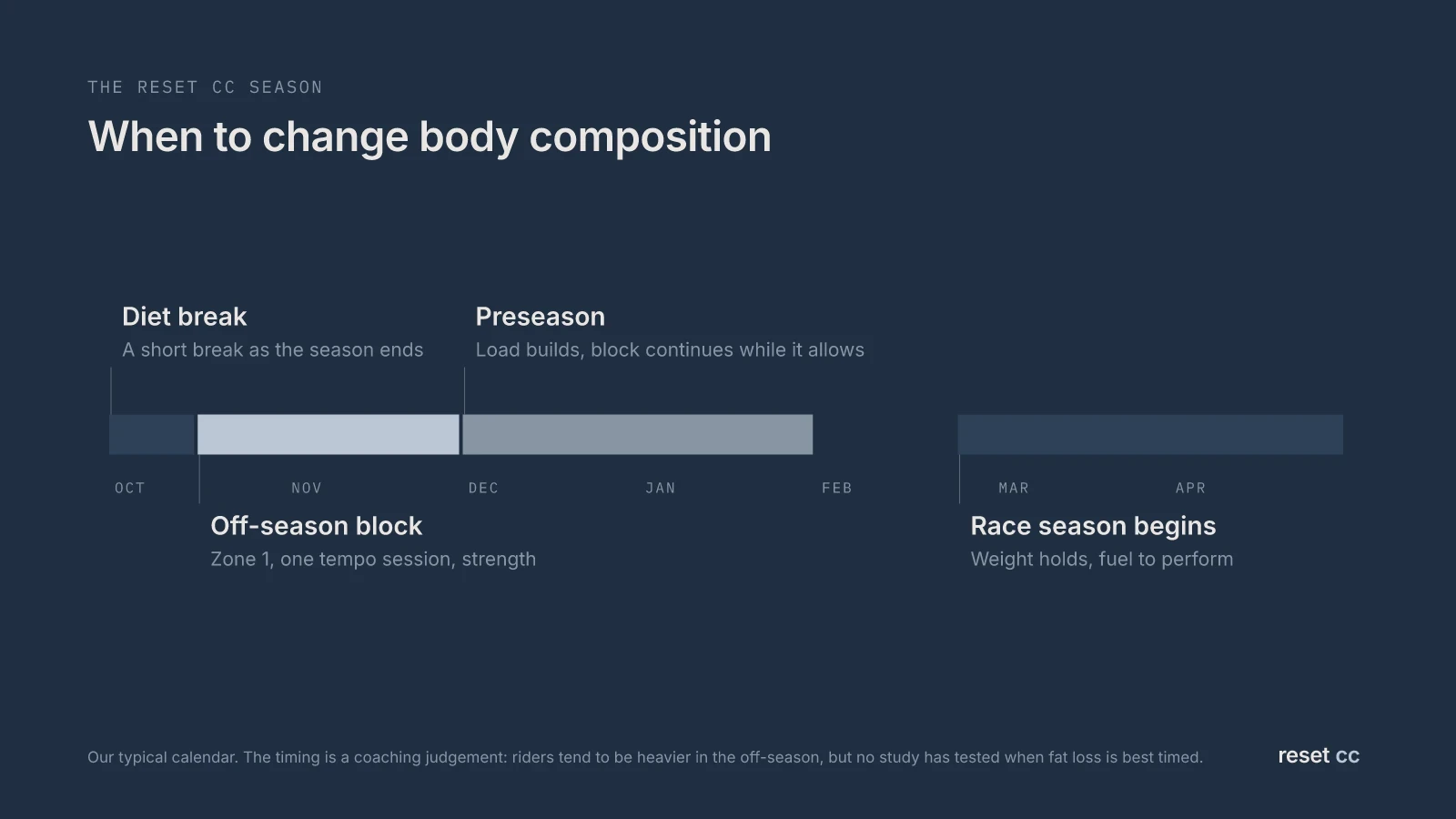
Our riders’ year usually runs like this:
Off-season, October to November. A short break from the diet as the season ends, then the start of the body composition block, alongside zone 1 riding, one tempo session a week and real strength work.
Preseason, December and January. Training builds, and the block continues while load allows.
Race season, starting between late February and April. Weight holds steady, and the focus moves to feeling good and driving power.
We choose the off-season and preseason because training is lighter and nothing is at stake if a week goes sideways. That’s a coaching judgement. Riders do tend to be slightly heavier in the off-season and leanest early in the season, but no study has tested when fat loss is best timed.
Why not lose weight in race season?
Racing and hard training need fuel. Trying to lose weight during a block of key sessions or a race week means arriving under-recovered, and it pushes energy availability down at the time you can least afford it. It’s also harder to stay consistent with your diet when every weekend is a race. If you didn’t change your body composition in the off-season, race with the body you have, fuel it properly and save the change for next winter.
How we set the deficit: the output is the budget
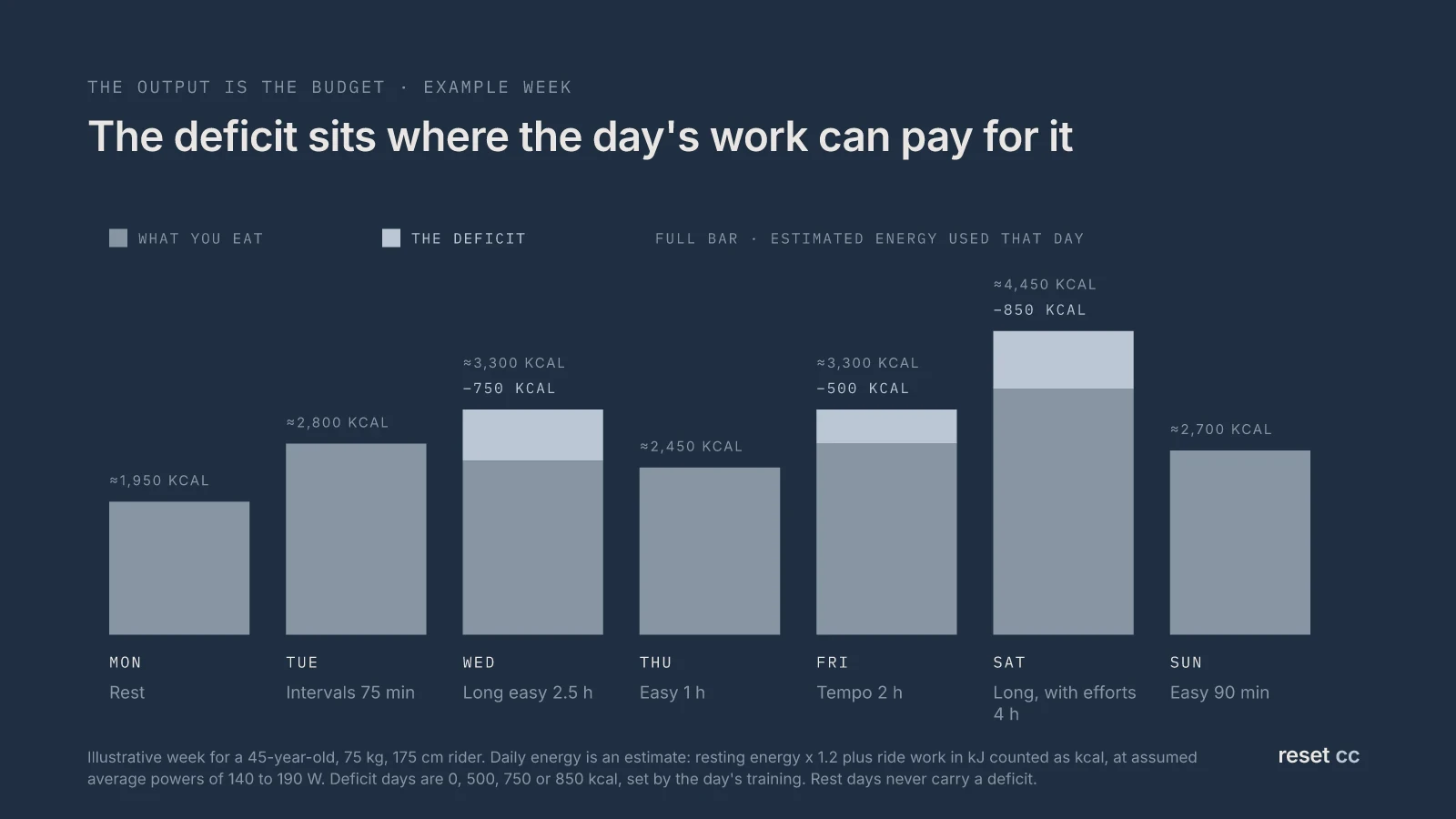
Every reset cc rider uses the same method, and I use it myself. We call it the output is the budget. Each day’s training sets how much you can eat, and the deficit sits where the day’s work can pay for it.
Protein stays roughly constant at 1.2 to 2 g per kg of body weight a day.
Fat stays roughly constant at about 55 to 65 g a day.
Carbohydrate moves with the work, set by how much glycogen the day’s training used and needs to be replaced.
The deficit comes from long days, easy or hard, where expenditure creates a large budget. Deficit days are 0, 500, 750 or 850 kcal, in no fixed order, set by the day’s training.
Rest days have no deficit. Their budget is smaller, and recovery comes first.
We run these blocks two to three times a year at most, and most of that work falls in the off-season and preseason. Any later block goes in a training period away from key races. Between blocks, weight holds steady and the priority is feeling good and driving power. Recovery always comes first: if sessions start to suffer, the deficit comes down.
Done slowly, the change doesn’t have to cost you fitness. Kenny lost about 22 lb in four months on an early version of this method, 30 lb over eight months in all, while adding 70 W at threshold. You can read how Kenny did it.
What the research says
Here’s how the method lines up with the evidence, graded: A strong, B good, C limited, D weak.
Question
What the research shows
Evidence
How fast should you lose weight?
Elite athletes losing about 0.7% of body mass a week kept lean mass better than those losing about 1% a week
B
How much protein in a deficit?
Sports nutrition guidance is 1.2 to 2.0 g/kg a day, and trials of athletes in a deficit used the top of that range or more
A for the range
Does strength training help?
It’s the best-supported way to protect lean mass in a deficit
B
Is low energy availability a risk?
Prolonged low energy availability is linked to hormonal, bone and performance problems in men and women, and cyclists are a known risk group
A
Is the off-season the best time?
Not tested. Riders tend to be heavier in the off-season, but no study compares timing
D
Does weight loss make you faster uphill?
At the same power, climbing speed on steep roads rises as total mass falls
A for the physics
Energy availability
Energy availability is the energy left for the rest of your body after training. It’s often quoted against a threshold of 30 kcal per kg of fat-free mass a day, but that figure comes from short lab studies in women, and the 2023 IOC consensus calls a universal cut-off debated.
Putting the deficit on a long day doesn’t change the arithmetic: energy availability falls by the size of the deficit, however long you rode. What the long day does is let you fuel the ride itself properly, and keep rest days whole. For a 75 kg rider with 62 kg of fat-free mass, the 750 and 850 kcal days put energy availability at about 25 and 23 kcal per kg of fat-free mass (estimate), inside the range where effects have been seen in men. That’s why we cap the deficit at 850 kcal, put the biggest deficits only on the biggest training days, keep them off rest days and run them in short blocks. It’s our coaching practice, not a tested protocol.
Protein for masters riders
Older muscle needs more protein per meal for the same response. In men around 71, muscle building plateaued at about 0.4 g/kg per meal, against 0.24 g/kg in men around 22. Applying that to riders aged 35 to 60 is an extrapolation, but it’s a good reason to spread protein across the day.
A note on fat
On the biggest days, 55 to 65 g of fat is a small share of total energy, below the 20% that sports nutrition guidance discourages going under for long periods. It’s one reason these blocks are time-limited, with weeks at maintenance in between.
Why the scale jumps between days
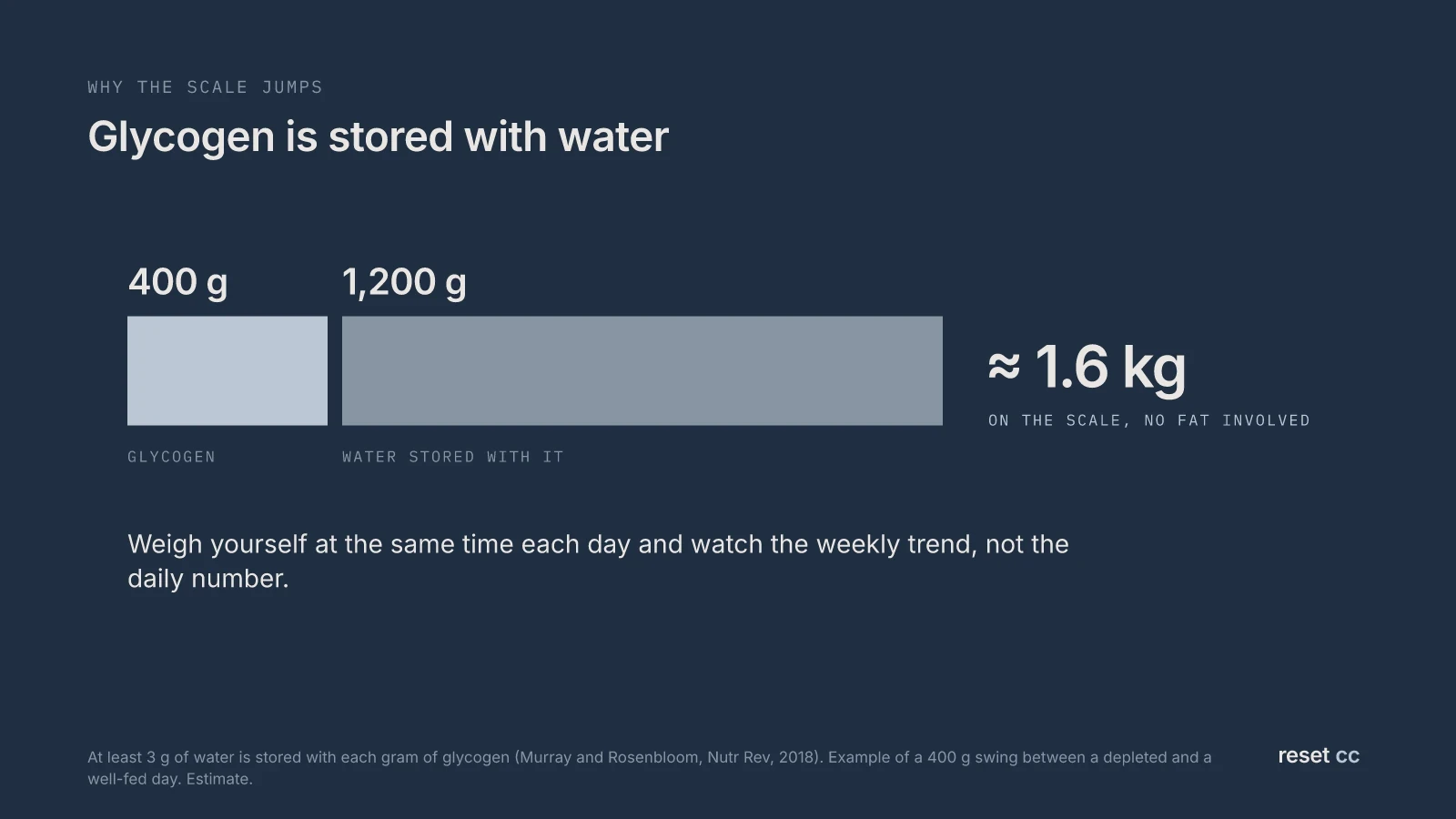
Glycogen, the carbohydrate stored in your muscles and liver, is stored with water: at least 3 g of water for every gram. Whole-body glycogen is usually estimated at 500 to 600 g in an average adult, and more in trained, well-fed riders with more muscle (evidence B). We use about 800 g as a practical planning ceiling, not a physiological limit.
That’s why weight can move by 1 to 2 kg from a big ride to a rest day without any change in fat. Weigh yourself at the same time each day and watch the weekly trend.
Weight and climbing speed
On a steep climb, the power you need is close to total mass times gravity times how fast you’re climbing. At the same power, climbing speed is roughly proportional to 1 divided by the total mass of you and your bike. A 90 kg rider on an 8 kg bike who loses 13.6 kg goes from 98 kg to 84.4 kg in total, about 14% lighter, which makes him about 16% faster up a steep climb at the same power (estimate). The gain is smaller on shallow roads, where air resistance matters more.
That only holds if power holds. Studies that pushed energy availability too low saw power fall, which is why the deficit never goes on the days that need the most recovery.
Who this isn’t for
Don’t run a weight loss block if you have a history of disordered eating, are recovering from an injury or illness, or are under 18. Talk to a doctor or a registered sports dietitian first if any of those apply.
12-week plan / start any Monday
The Reset Off-Season
This is how I sequence the off-season for the athletes I coach, written so you can ride it on your own. It takes you from the end of the off-season through the preseason, with every session laid out.
Riding hours per week, Standard tier. Strength adds about 2 h.
Foundation and torque
Weeks 1 to 4
On the bike
Most riding in zone 1, with zone 2 ridden as a session of its own
Seated torque efforts at 50 to 60 rpm, from 4 by 6 min to 5 by 8 min
First tempo in week 3, FTP test in week 1
In the gym
Two weeks of technique, then single-leg main lifts at 4 to 6 reps.
Every main lift is single-leg, with no barbell and no load across your back.
Pick your tier
All three ride the same key sessions.
Riding
5 h 30 to 11 h a week
Long ride
Up to 4 h
Sessions
57 rides and 20 strength sessions
Choose it ifYou ride 8 to 10 hours a week in season.
What you get
The GuideThe reasoning behind every session, the zone model, the 18-exercise strength program and the fuelling page.
Your calendarEvery session by week and day for your tier, as a PDF and a spreadsheet.
Workout filesEvery ride in .zwo, .mrc and .fit, for Zwift, TrainerRoad, TrainingPeaks, Intervals.icu, Garmin and Rouvy.
The calculatorYour carbohydrate, protein, fat and energy for every day of the 12 weeks, set for your goal.
The courseA lesson for each part of the plan, with strength log sheets for every phase.
You need a power meter or smart trainer, and a gym with heavy dumbbells or kettlebells. A home version of the strength program is included.
In the off-season and preseason, when training is lighter and nothing is at stake. That’s a coaching judgement rather than a tested finding, but it keeps the deficit away from key sessions and races.
How fast should a cyclist lose weight?
Slowly. In elite athletes, losing about 0.7% of body mass a week kept lean mass better than about 1% a week. In the structured phase of his plan, Kenny lost about 0.6 kg a week, roughly 0.65% of his body mass (estimate).
Should I eat less on rest days?
Not at reset cc. Rest days have a smaller budget because you burned less, but no deficit, so recovery and adaptation aren’t compromised.
How much protein should I eat in a deficit?
We set protein at 1.2 to 2 g per kg a day. Trials of athletes in a deficit used the top of that range or more, and older riders need more protein per meal.
Why does my weight change so much from day to day?
Mostly glycogen and the water stored with it. A 400 g change in glycogen can move the scale by about 1.6 kg. Watch the weekly trend.
Coaching and membership · 2027 season
Want a coach to run your off-season?
reset cc riders get their training, strength and daily nutrition written week by week, with the deficit set from their own training.
Team membership · 2027 season
Race the 2027 season with the team
Three levels, from one team camp to the whole season on the road to Worlds. Every level includes:
✓Your own reset cc coach
✓Strength and nutrition
✓Two calls a month
✓Your roadmap to Worlds
✓The Girona block
✓The full custom team kit
+Team Rider and Full Season add the team bike and more race camps
Zack Morris is the founder of reset cc. Silver medalist, M35-39 time trial, 2026 UCI Gran Fondo World Championships. National champion, elite and masters. Built and ran Team EF Coaching for five years.