Metabolic flexibility in cycling: what the research says
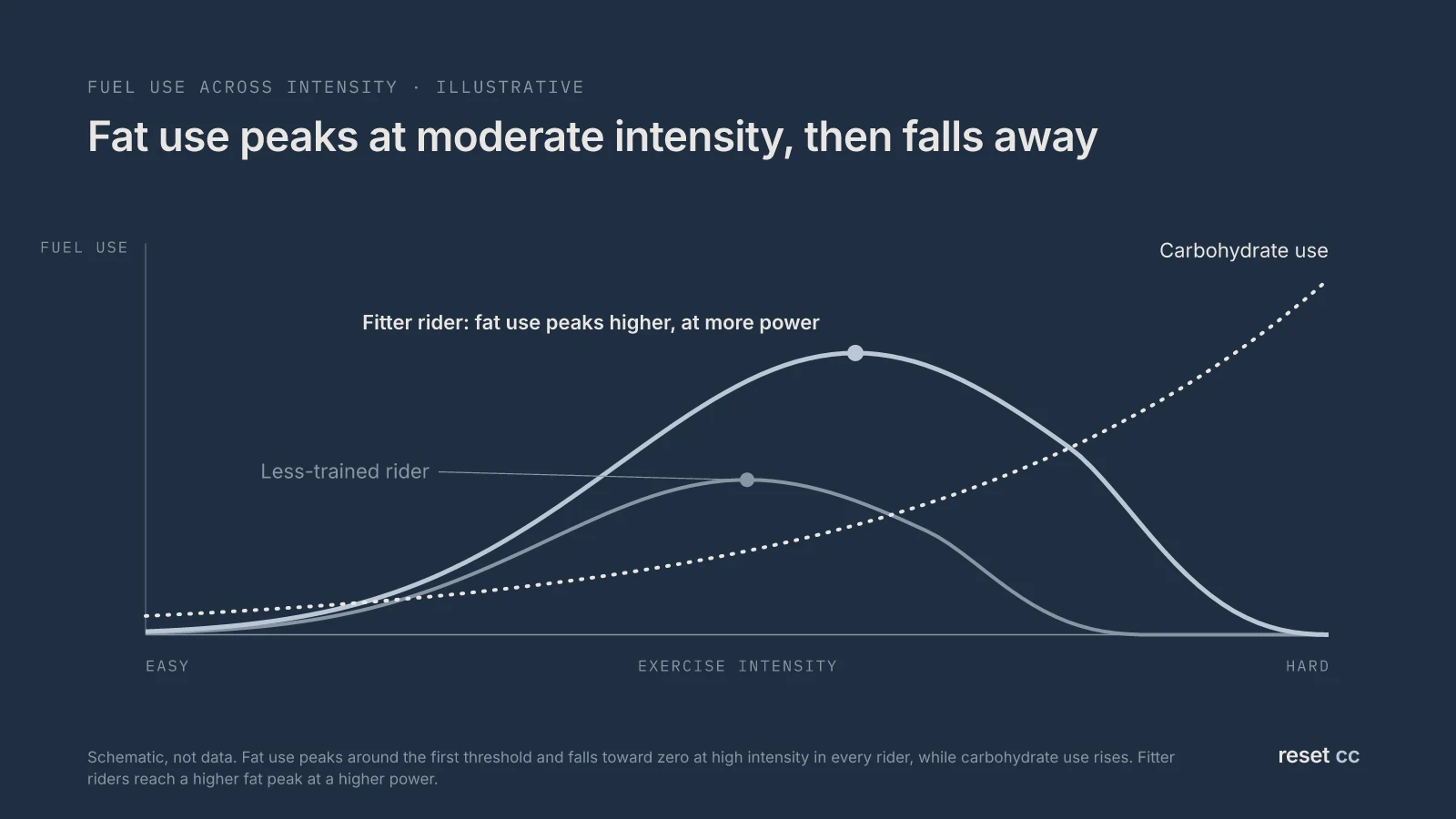
Metabolic flexibility describes how well your body matches its fuel, fat or carbohydrate, to what you’re asking of it. Fitter riders burn more fat at a given power and keep more carbohydrate for the hard parts of a race, and aerobic training is what builds that (evidence B). Matching carbohydrate to the work of each session is a sound framework, though it hasn’t been shown to improve performance on its own (evidence C). The research doesn’t support chasing maximum fat burning: in the best controlled trials, keto diets made elite athletes less economical and slower. This is what the evidence says, graded, and how we apply it at reset cc.
What metabolic flexibility means
The term comes from diabetes research. In 2000, Kelley and Mandarino used it to describe healthy muscle’s ability to burn mostly fat when fasting and switch to glucose when insulin rises, a switch that insulin resistance blunts. In sport the term is used more loosely, for how well fuel use tracks exercise demand. There is no agreed test for it.
In a rider, it shows up in two places. At easy and moderate intensities, a flexible rider gets more of their energy from fat, which spares glycogen. At high intensities, everyone relies mostly on carbohydrate, and a flexible rider can use it well when it counts.
What it looks like in real riders
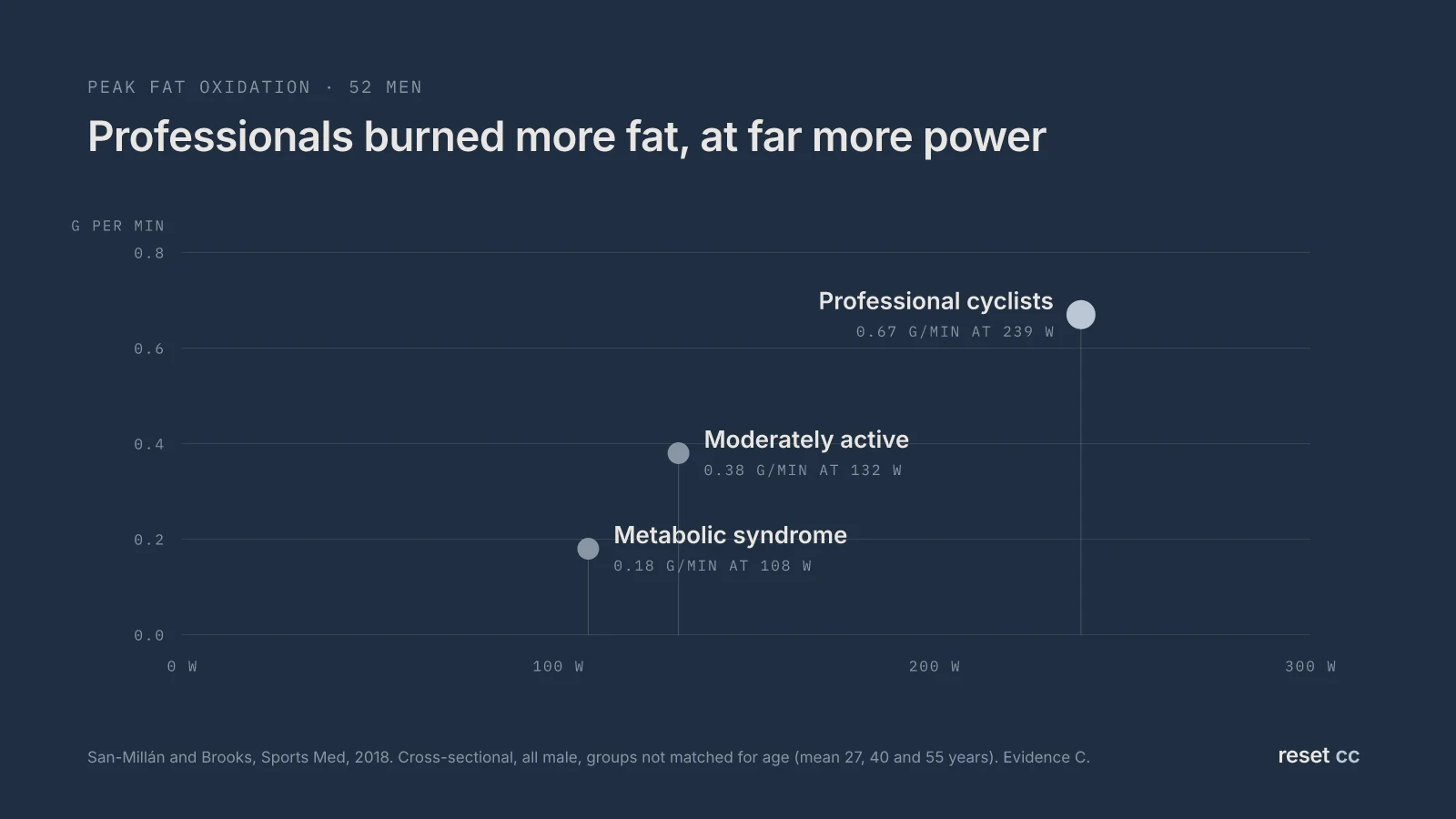
In a 2018 study of 52 men, San-Millán and Brooks compared professional road cyclists with moderately active men and men with metabolic syndrome. The professionals burned fat at a peak of about 0.67 g per minute at about 239 W. The moderately active men peaked at 0.38 g per minute at 132 W, and the men with metabolic syndrome at 0.18 g per minute at 108 W. Professionals also had lower blood lactate at comparable power.
It’s a striking picture, with real limits. The study was cross-sectional, all male, and the groups weren’t matched for age, so it can’t show what causes what. The two non-professional groups also peaked at the first stage of the test, so their real peaks were probably missed. Fitness also explains only part of the difference between people. In a study of 300 adults, fitness, activity level and sex together explained 12% of the variation in peak fat oxidation. Across 1,121 athletes, peak fat oxidation averaged 0.59 g per minute and occurred anywhere from 23% to 89% of VO2max (a study funded by the Gatorade Sports Science Institute, part of PepsiCo).
FatMax, LT1 and zone 2
FatMax is the intensity where you burn the most fat. On average it sits a little below your first lactate or ventilatory threshold, by about 22 W or 11 beats per minute across 42 studies. The gap varies a lot between individuals, so one can’t stand in for the other without testing.
Our zones are anchored to lactate. Most of our riders’ volume sits in zone 1. Zone 2 sits just below the first lactate threshold and counts as a harder session. If your zone 2 is set from a lactate test, it will usually sit close to your FatMax, but don’t call it your FatMax unless you’ve measured it.
What the research says about the popular methods
Method
What the trials found
Evidence
Building aerobic fitness
Fitter riders burn more fat at a given power, though fitness explains only part of the difference between people
B
Training fasted
In 20 young men over six weeks, muscle enzymes rose more with fasted training, but fat use during exercise, VO2max and time-trial performance improved equally in both groups
C
Train low or sleep low
Some sessions with low carbohydrate boost training signals in muscle, but a meta-analysis of nine studies found no overall performance benefit
A for no benefit
Keto or low-carb, high-fat diets
Fat burning roughly doubles, but in elite race walkers the oxygen cost of race pace rose and the performance gain from training disappeared
B
Carbohydrate during long rides
30 to 60 g an hour for 1 to 2.5 hour sessions, and up to 90 g an hour beyond that with glucose and fructose
A
Two of these deserve more detail.
Fasted training. In Van Proeyen’s six-week trial in active young men who weren’t endurance-trained, the fasted group’s muscle enzymes and the power at their peak fat oxidation rose more than in the group training with carbohydrate. But the share of energy from fat during a two-hour fasted ride rose in both groups, and VO2max (up 9%) and 60 minute time-trial performance (up 8%) improved equally. A meta-analysis of 46 studies found that eating before exercise improved prolonged aerobic performance (evidence B).
Keto diets. A study of keto-adapted ultra-endurance athletes found fat burning of about 1.5 g per minute, roughly double that of athletes on high-carbohydrate diets. It was cross-sectional, didn’t measure performance and was funded by organisations with an interest in low-carbohydrate diets. In Burke’s controlled trials in elite race walkers, who were allocated to diets by preference rather than at random, three weeks of keto adaptation raised the oxygen cost of race pace, and the walkers on high-carbohydrate and periodised diets improved their 10 km times while the keto group didn’t. A short return to carbohydrate restored neither carbohydrate use nor performance (evidence B). In eight cyclists, fat adaptation followed by carbohydrate loading left 100 km time-trial time unchanged but cut 1 km sprint power (evidence C).
How we build metabolic flexibility at reset cc
What follows is our coaching practice. Where the research is behind it, we say so.
Build the aerobic engine with volume
Most masters riders can absorb about two hard sessions a week, three in a big week. Zone 1 fills the days in between and protects the quality of those sessions. Volume is what builds the engine, and a bigger engine burns more fat at any given power.
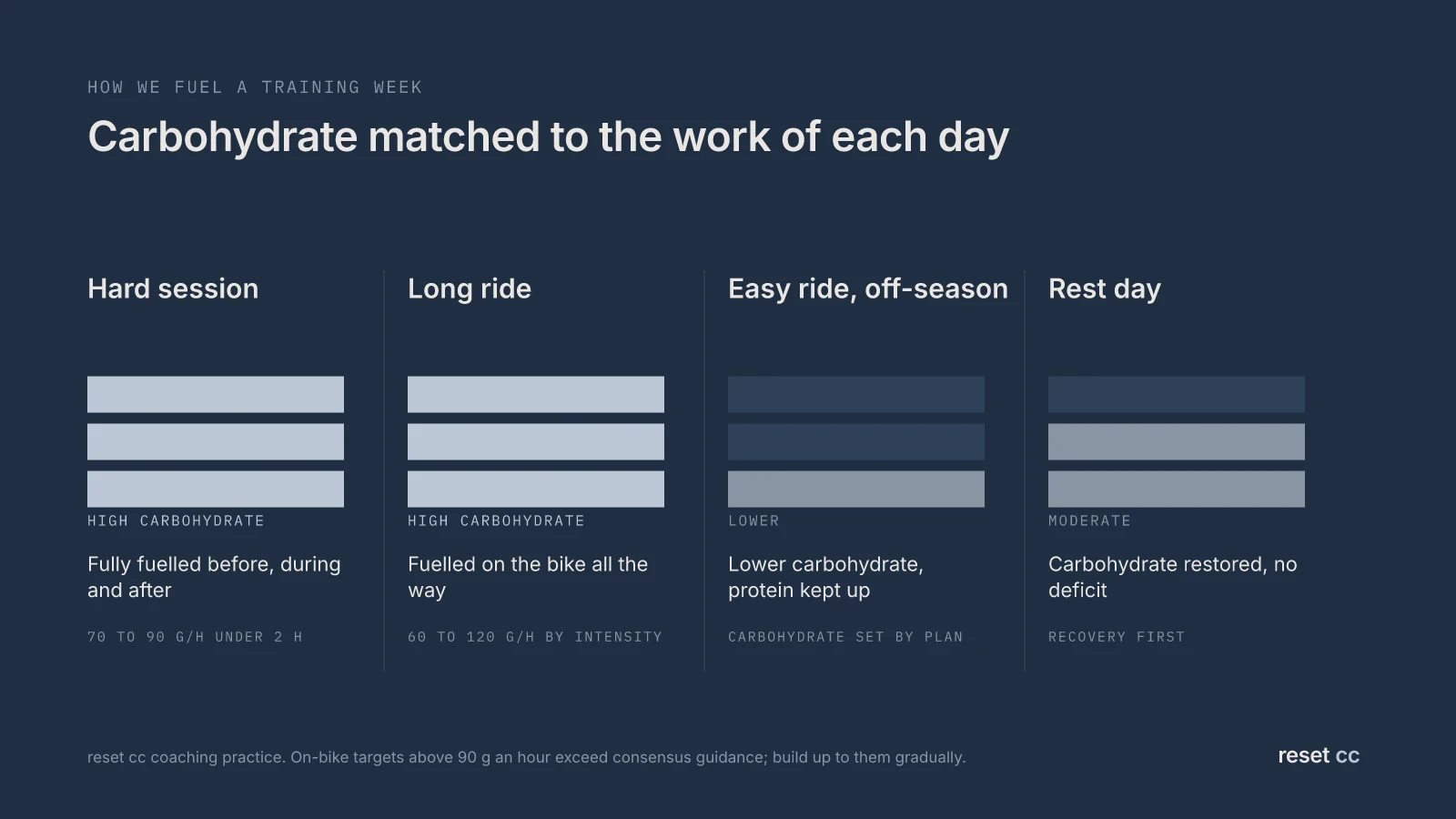
Fuel each session for the work it asks of you
Hard sessions are fully fuelled, before, during and after. In the off-season, some easy rides are done with lower carbohydrate, and hard sessions stay fully fuelled. This contrast fits the “fuel for the work required” framework from Impey and colleagues (evidence C). We don’t promise that it improves performance on its own, because the trials haven’t shown that.
Eat enough carbohydrate on the bike
These are the targets we use:
Easy rides under 2 hours: 30 to 60 g an hour
Easy rides over 2 hours: 60 to 90 g an hour
Hard rides under 2 hours: about 70 to 90 g an hour
Hard rides over 2 hours: 90 to 120 g an hour
These are coaching targets for fuelled rides, outside planned low-carbohydrate rides, and some sit above consensus guidance, which tops out at 90 g an hour. Trained riders absorb and burn more carbohydrate at 120 g an hour than at 90, but trials haven’t yet shown a performance benefit above 90 g an hour. Lighter riders burn less of what they take in (evidence C), so they should build up gradually.
Don’t forget protein on low-carbohydrate days
Training with low carbohydrate availability can raise protein needs (evidence C). Easy low-carbohydrate rides should still sit inside a day with enough protein.
Measure it properly if you want to know
Blood lactate profiling is a practical way to locate your thresholds, as long as the protocol, the pre-test diet and the threshold method stay the same between tests. Estimates of fat and carbohydrate burning from breath gases are reasonable at steady state, but they become unreliable above the second threshold, so treat ramp-test readings at high intensity with caution (evidence B).
Common mistakes
Chasing maximum fat burning. It’s a marker of fitness, and there’s no trial showing that raising it improves race performance.
Going keto for endurance racing. The best trials in elite athletes show worse economy and no performance benefit.
Training fasted every day. It adds stress and has not beaten fuelled training for performance.
Under-fuelling hard sessions. The work you can do in your key sessions drives adaptation. Fuel them.
12-week plan / start any Monday
The Reset Off-Season
This is how I sequence the off-season for the athletes I coach, written so you can ride it on your own. It takes you from the end of the off-season through the preseason, with every session laid out.
Riding hours per week, Standard tier. Strength adds about 2 h.
Foundation and torque
Weeks 1 to 4
On the bike
Most riding in zone 1, with zone 2 ridden as a session of its own
Seated torque efforts at 50 to 60 rpm, from 4 by 6 min to 5 by 8 min
First tempo in week 3, FTP test in week 1
In the gym
Two weeks of technique, then single-leg main lifts at 4 to 6 reps.
Every main lift is single-leg, with no barbell and no load across your back.
Pick your tier
All three ride the same key sessions.
Riding
5 h 30 to 11 h a week
Long ride
Up to 4 h
Sessions
57 rides and 20 strength sessions
Choose it ifYou ride 8 to 10 hours a week in season.
What you get
The GuideThe reasoning behind every session, the zone model, the 18-exercise strength program and the fuelling page.
Your calendarEvery session by week and day for your tier, as a PDF and a spreadsheet.
Workout filesEvery ride in .zwo, .mrc and .fit, for Zwift, TrainerRoad, TrainingPeaks, Intervals.icu, Garmin and Rouvy.
The calculatorYour carbohydrate, protein, fat and energy for every day of the 12 weeks, set for your goal.
The courseA lesson for each part of the plan, with strength log sheets for every phase.
You need a power meter or smart trainer, and a gym with heavy dumbbells or kettlebells. A home version of the strength program is included.
It’s how well your body matches its fuel, fat or carbohydrate, to the demand of the moment. The term comes from diabetes research, and in sport it’s used for how well fuel use tracks exercise intensity. There’s no agreed test for it.
Does fasted training improve cycling performance?
Not on its own, as far as the evidence goes. In a six-week trial, fasted training raised muscle enzymes more, but time-trial performance improved equally with fuelled training.
Is a keto diet good for cyclists?
The best controlled trials say no for racing. Keto adaptation raises fat burning, but in elite race walkers it made them less economical and wiped out the performance gain from training, and a short return to carbohydrate didn’t reverse it.
How many carbs per hour should I eat on the bike?
Consensus guidance is 30 to 60 g an hour for 1 to 2.5 hour sessions and up to 90 g an hour for longer ones. We use up to 120 g an hour for long, hard rides, built up gradually in training.
Is zone 2 the same as FatMax?
They’re close on average, with FatMax a little below the first threshold, but they can differ a lot in an individual rider. Only a test tells you where yours is.
Coaching and membership · 2027 season
Fuelling built around your training
Every reset cc rider gets training, strength and a nutrition plan matched to each day's work, written week by week for their schedule.
Team membership · 2027 season
Race the 2027 season with the team
Three levels, from one team camp to the whole season on the road to Worlds. Every level includes:
✓Your own reset cc coach
✓Strength and nutrition
✓Two calls a month
✓Your roadmap to Worlds
✓The Girona block
✓The full custom team kit
+Team Rider and Full Season add the team bike and more race camps
Zack Morris is the founder of reset cc. Silver medalist, M35-39 time trial, 2026 UCI Gran Fondo World Championships. National champion, elite and masters. Built and ran Team EF Coaching for five years.