Torque training for cyclists: what the research says

Torque training means riding low-cadence, high-force intervals, usually at 50 to 70 rpm and tempo to threshold power. A handful of small studies suggest it can help some riders, but it has not been shown to beat the same work done at your normal cadence, and it is far too light to build maximal strength. At reset cc we use it as one tool early in the off-season, paired with high-cadence work and real strength training in the gym. This is what it does, what the evidence says and the three sessions we use.
What torque training is
A torque interval is a block of steady riding in a big gear at a low cadence. At the same power, a lower cadence means more force on every pedal stroke, so the session shifts the work toward force and away from leg speed.
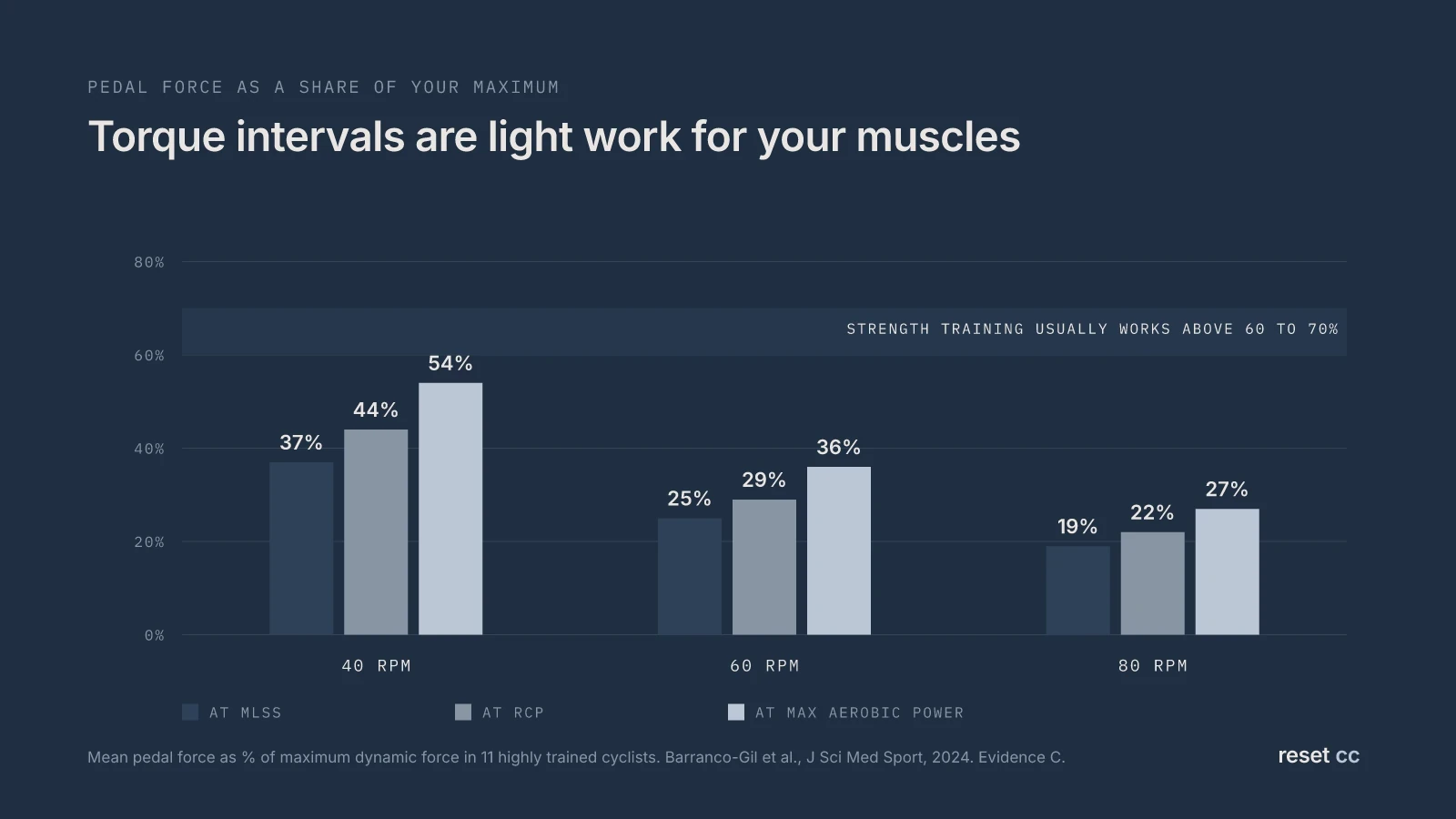
It is still light work for your muscles. When researchers measured pedal force in 11 highly trained cyclists, a typical torque interval at 60 rpm and threshold-type power used about 25 to 30% of each rider’s maximum pedal force. Even at 40 rpm and maximal aerobic power it reached only 54%. Strength training normally works above 60 to 70% of maximum.
What the research says about torque training
The research is small, short and mixed. Here’s where it stands, with an evidence grade for each finding: A strong, B good, C limited, D weak.
Question | What the studies found | Evidence |
|---|---|---|
Do low-cadence intervals beat high-cadence intervals? | Two four-week trials of 18 cyclists each favoured low cadence for peak power, power at 4 mmol/L lactate and 20 minute time-trial power | C |
Do they beat the same work at your own cadence? | No clear benefit. A 12-week trial in riders averaging 47 found none | C |
Do torque intervals build strength? | Typical loads are 25 to 45% of maximum pedal force, too light for maximal strength | C |
Does heavy strength training help cyclists? | It improves time-trial performance, efficiency and peak power, without raising VO2max | B |
Does pairing torque and cadence work in one session add fitness? | Not tested | D |
Do cadence drills fix your pedalling technique? | No good evidence beyond normal training | D |
The two positive trials are worth knowing. Paton and colleagues found that 60 to 70 rpm sprint intervals improved peak power by 3.6% and power at 4 mmol/L lactate by 7.0% more than the same work at 110 to 120 rpm. Nimmerichter and colleagues found that 60 rpm uphill intervals raised 20 minute time-trial power on both flat and uphill courses. Neither study compared low cadence with the rider’s own cadence.
When that comparison was made, the advantage disappeared. In Kristoffersen’s 12-week study, veteran cyclists added 5 x 6 minute intervals at 40 rpm twice a week and improved nothing, leg strength included, while the same volume at their own cadence improved VO2max and threshold power. A 2017 systematic review of seven studies found no strong evidence that low-cadence training beats normal cadence.
Why we still use it
If torque work doesn’t build strength and doesn’t beat normal-cadence work in trials, why keep it? Three reasons, all coaching practice rather than proven method:
It teaches force control on the bike. Riding steady at 50 to 60 rpm asks you to stay stable on the saddle, keep your upper body quiet and push through the whole stroke. That carries over to steep climbs and to riding a time trial position.
It’s a low-cost way to start the off-season. Torque intervals at tempo give a real training stimulus at modest intensity, when the goal is to build back without frying the system.
It sets up the transition to speed. Pairing torque blocks with high-cadence blocks prepares riders for the surges and gradient changes of real racing.
Our view that muscular, power-oriented riders often climb better by lowering their cadence on long, steady climbs also comes from coaching experience. The research is more nuanced. At endurance intensities, slightly lower cadences cost a little less oxygen. At hard efforts, higher cadences cut the force needed per stroke, along with heart rate and lactate. Professional riders averaged about 71 rpm on mountain passes against 89 to 92 rpm on flat stages and time trials (evidence B for the cadence and economy findings).
Where torque work fits in an off-season
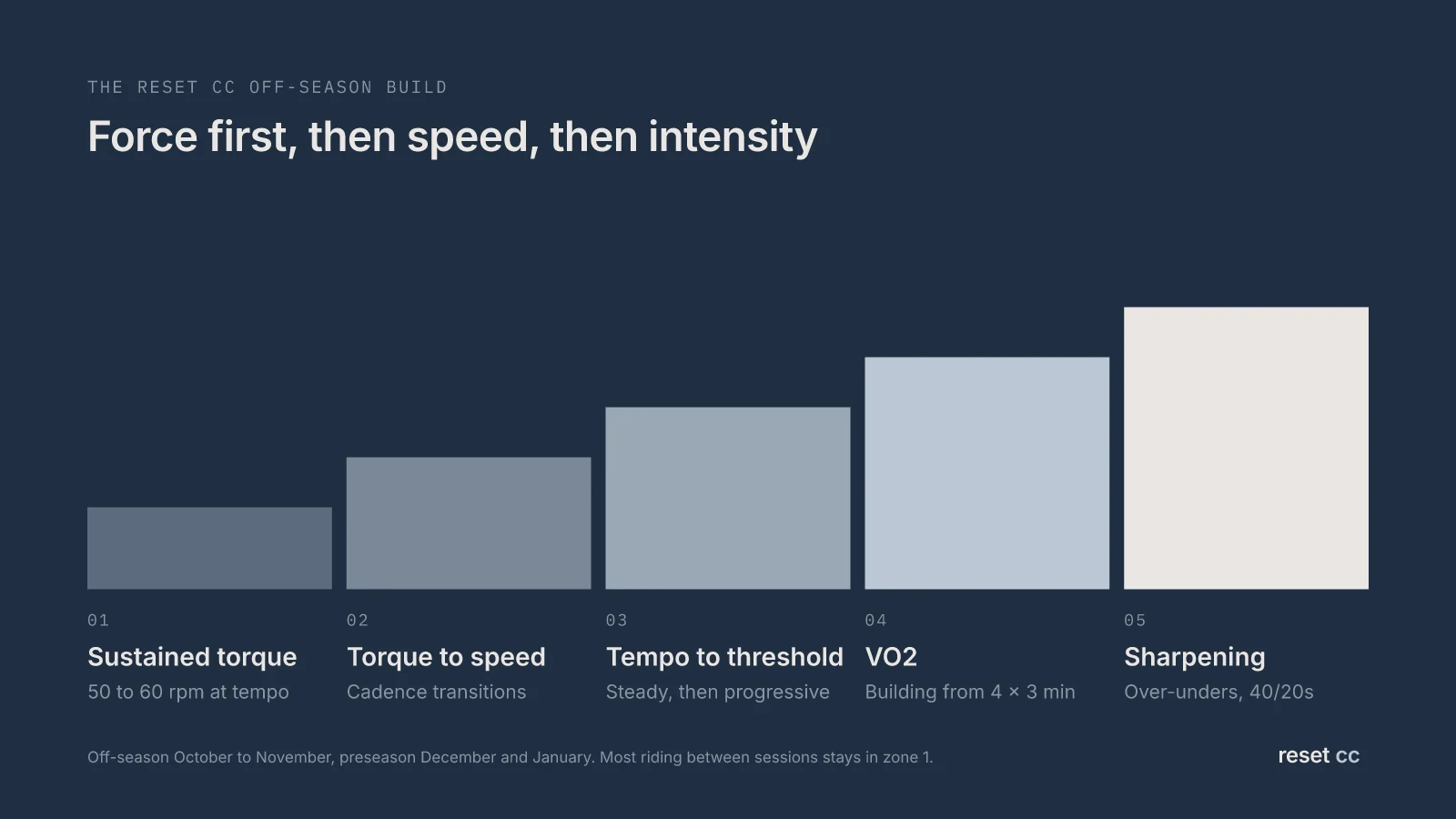
We build the off-season in this order:
Sustained torque efforts at tempo
Torque to speed transitions
Tempo and progressive tempo to threshold efforts
VO2 work
Sharpening with over-unders, 40/20s and 20/40s
Most of the riding around these sessions stays in zone 1, with one tempo session a week in the early off-season.
Three torque and cadence sessions
1. Sustained torque
5 x 6 minutes at 50 to 60 rpm at tempo power, with 3 to 4 minutes of easy spinning between efforts. Stay seated and keep your upper body still. Once a week early in the off-season, where it works as the week’s tempo session.
2. Torque to speed
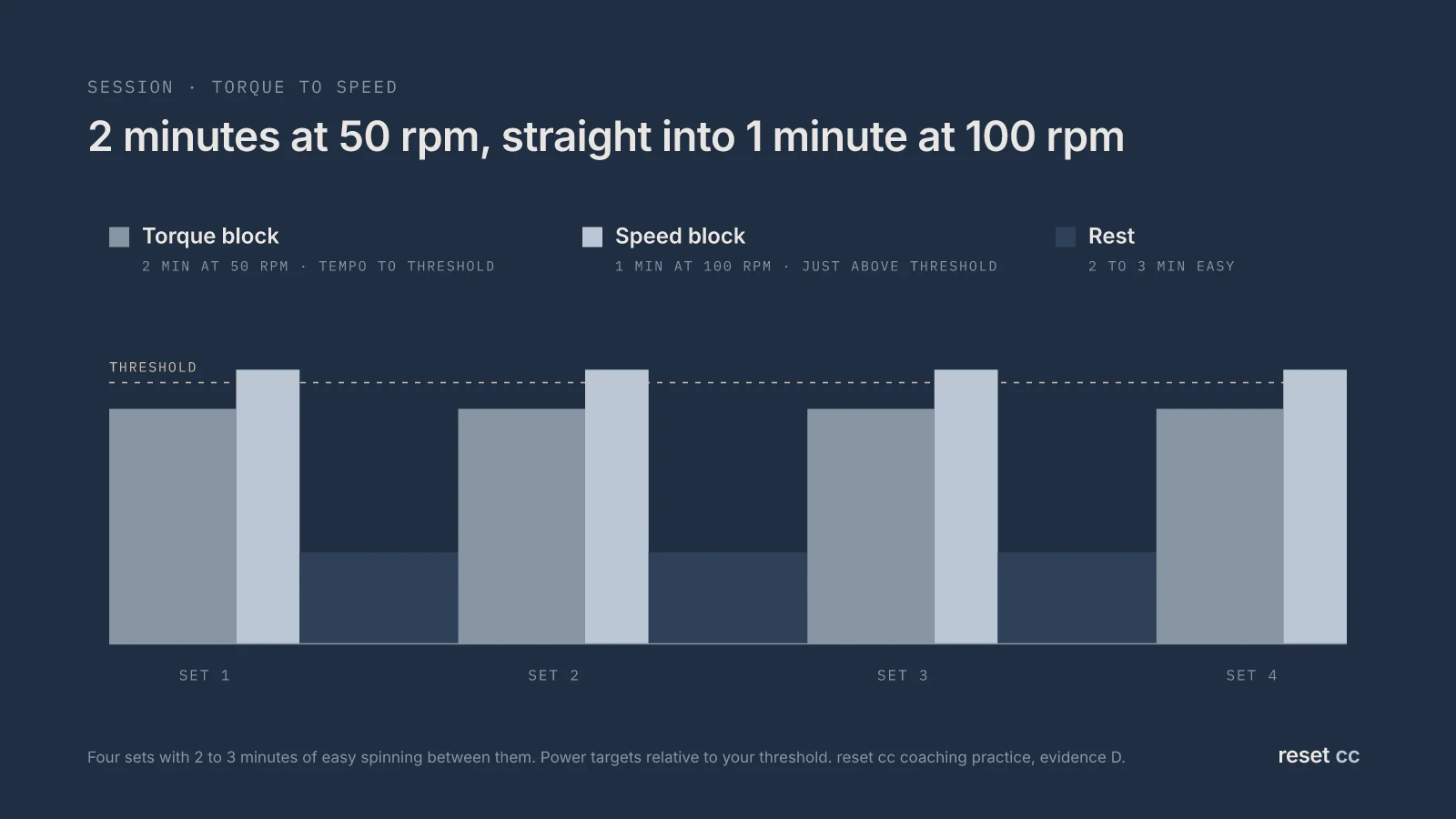
2 minutes at 50 rpm, then straight into 1 minute at 100 rpm, with the power stepping up for the high-cadence minute. The torque block sits at tempo to threshold power and the speed block a little above threshold. Rest 2 to 3 minutes, and do 4 sets.
I first rode this session in Colombia, on the wheel of one of the riders coached by Michele Bartoli, who later became a colleague of mine while I ran Team EF Coaching. I remember telling myself I wasn’t letting go of that wheel whatever happened. I liked how it felt and started building it into my athletes’ training.
In The Reset Off-Season plan, the torque to speed blocks are a simpler version: you hold the power steady while the cadence moves from 55 to 105 rpm.
3. High-cadence neuromuscular work
6 to 10 second efforts at 110 to 120 rpm, fully recovered between each one. These are neural efforts and they shouldn’t make you tired. One study found that high-cadence intervals made riders more efficient at high cadence. There is no good evidence that drills like these fix your pedalling technique beyond what normal training does.
Torque training doesn’t replace the gym
Heavy strength training is the method with the better evidence. A 2025 meta-analysis of 17 studies and 262 cyclists found that it improved performance, efficiency and peak power, although the certainty of the evidence was rated low. It doesn’t raise VO2max.
Our strength work is single-leg, so each side has to work and stabilise on its own, with low reps, typically 4 to 6. We avoid loading the spine, so no back squats, front squats or deadlifts; the goblet squat is fine. Single-leg and two-leg training build similar muscle in the research (evidence C), although our exact model hasn’t been tested in cyclists. Real strength work belongs in the off-season and preseason. In season it’s maintenance, mobility and some explosive work, and we pull heavy strength at least two weeks before a race.
What torque training won’t do
It won’t turn an average rider into a fast one, replace the aerobic work that builds your engine or make up for poor training structure and recovery. Used well, it adds force control and variety to the first weeks of a structured off-season.
12-week plan / start any Monday
The Reset Off-Season
This is how I sequence the off-season for the athletes I coach, written so you can ride it on your own. It takes you from the end of the off-season through the preseason, with every session laid out.
Riding hours per week, Standard tier. Strength adds about 2 h.
Foundation and torque
Weeks 1 to 4On the bike
- Most riding in zone 1, with zone 2 ridden as a session of its own
- Seated torque efforts at 50 to 60 rpm, from 4 by 6 min to 5 by 8 min
- First tempo in week 3, FTP test in week 1
In the gym
Two weeks of technique, then single-leg main lifts at 4 to 6 reps.
Every main lift is single-leg, with no barbell and no load across your back.
Pick your tier
All three ride the same key sessions.
- Riding
- 5 h 30 to 11 h a week
- Long ride
- Up to 4 h
- Sessions
- 57 rides and 20 strength sessions
Choose it ifYou ride 8 to 10 hours a week in season.
What you get
You need a power meter or smart trainer, and a gym with heavy dumbbells or kettlebells. A home version of the strength program is included.
Frequently asked questions
What cadence is torque training?
Usually 50 to 70 rpm, held steady at tempo to threshold power. Some studies have used cadences as low as 40 rpm.
Does low-cadence training build leg strength?
Not much. Typical torque intervals use about 25 to 45% of your maximum pedal force, while strength training works above 60 to 70%. A 12-week study of torque intervals found no strength gain.
Is torque training better than riding at my normal cadence?
The research hasn’t shown that. Small trials favour low cadence over very high cadence, but the same work at your own cadence did as well or better in a longer trial.
Should cyclists do strength training as well?
Yes. Heavy strength training improves time-trial performance, efficiency and sprint power in cyclists (evidence B, with low certainty). We use single-leg exercises at 4 to 6 reps, without loading the spine.
Sources
Paton CD, Hopkins WG, Cook C (2009). Effects of low- vs high-cadence interval training on cycling performance. J Strength Cond Res. Evidence C.
Nimmerichter A et al. (2012). Effects of low and high cadence interval training on power output in flat and uphill cycling time-trials. Eur J Appl Physiol. Evidence C.
Kristoffersen M et al. (2014). Low cadence interval training at moderate intensity does not improve cycling performance in highly trained veteran cyclists. Front Physiol. Evidence C.
Hansen EA, Rønnestad BR (2017). Effects of cycling training at imposed low cadences: a systematic review. Int J Sports Physiol Perform. Evidence C.
Barranco-Gil D et al. (2024). Relative pedaling forces are low during cycling. J Sci Med Sport. Evidence C.
Llanos-Lagos C et al. (2025). Heavy strength training effects on physiological determinants of endurance cyclist performance: a meta-analysis. Eur J Appl Physiol. Evidence B.
Kassiano W et al. (2025). Unilateral and bilateral resistance training: a meta-analysis. Sports Med. Evidence C for cyclists.
Whitty AG et al. (2016). The effect of low- vs high-cadence interval training on the freely chosen cadence and performance. Appl Physiol Nutr Metab. Evidence C.
Foss Ø, Hallén J (2004). The most economical cadence increases with increasing workload. Eur J Appl Physiol. Evidence B.
Lucia A et al. (2004). In professional road cyclists, low pedaling cadences are less efficient. Med Sci Sports Exerc. Evidence B.
Lucía A et al. (2001). Preferred pedalling cadence in professional cycling. Med Sci Sports Exerc. Evidence B.
Zack Morris is the founder of reset cc. Silver medalist, M35-39 time trial, 2026 UCI Gran Fondo World Championships. National champion, elite and masters. Built and ran Team EF Coaching for five years.