Cycling durability: what Quinn Simmons’ Worlds file shows, and how to test yours
Durability is your ability to produce as much of your fresh power as possible late in a ride. Most riders know their FTP and their best 5 minutes when fresh. Far fewer know how much of that is still there after four or five hours, which is usually when a gran fondo is decided.
The cleanest way to measure “late” is work done, in kilojoules (kJ), which most head units can show. Time alone hides how hard the ride was: an hour sheltered in the bunch costs far less work than an hour on the front.
Below I break down Quinn Simmons’ file from the 2026 World Championships road race in Montreal, show how much riders fade at each level, and give you the test I use with my own riders.
What Quinn Simmons did at Worlds
Quinn Simmons finished 4th in the elite men’s road race in Montreal and was an important part of Brandon McNulty’s win. He made his race file public on Strava, so we can see exactly how his power held up.
The race took him 6 h 24 min over 276 km: about 6,714 kJ of work at 291 W average and 361 W normalized. The first 116 km of racing cost him about 2,030 kJ at 218 W. Then came 12 laps, each over Camillien-Houde, which averages close to 8%.
Effort
Power
W/kg (70 to 73 kg)
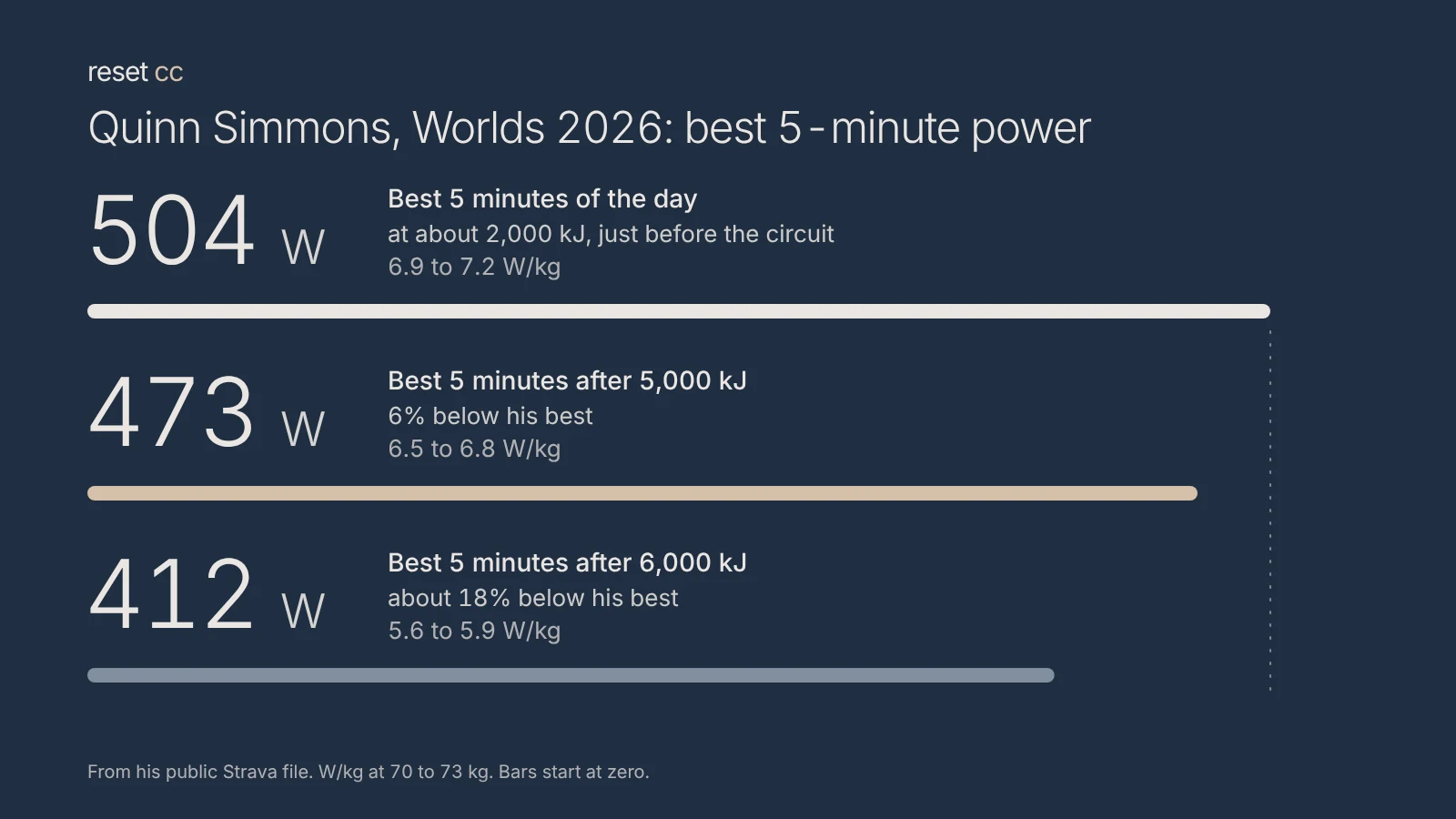
Best 5 min of the day, at about 2,000 kJ
504 W
6.9 to 7.2
Best 5 min after 5,000 kJ
473 W, 6% below his best
6.5 to 6.8
Best 5 min after 6,000 kJ
412 W, about 18% below
5.6 to 5.9
Best 1 min of the day, after more than 4,000 kJ
659 W
9.0 to 9.4
For context, riding 4 hours at 200 W average is about 2,900 kJ. After 5,000 kJ of racing, Quinn could still hold 473 W for five minutes, and his best minute of the day came after 4,000 kJ.
The W/kg column is a range on purpose. ProCyclingStats lists him at 73 kg; my own estimate is that he is closer to 70 kg now.
A race file shows what a rider did, not his ceiling. By the final laps his teammate was clear and Quinn had no reason to chase, so that last number reflects the race situation as much as fatigue.
The reset cc durability chart
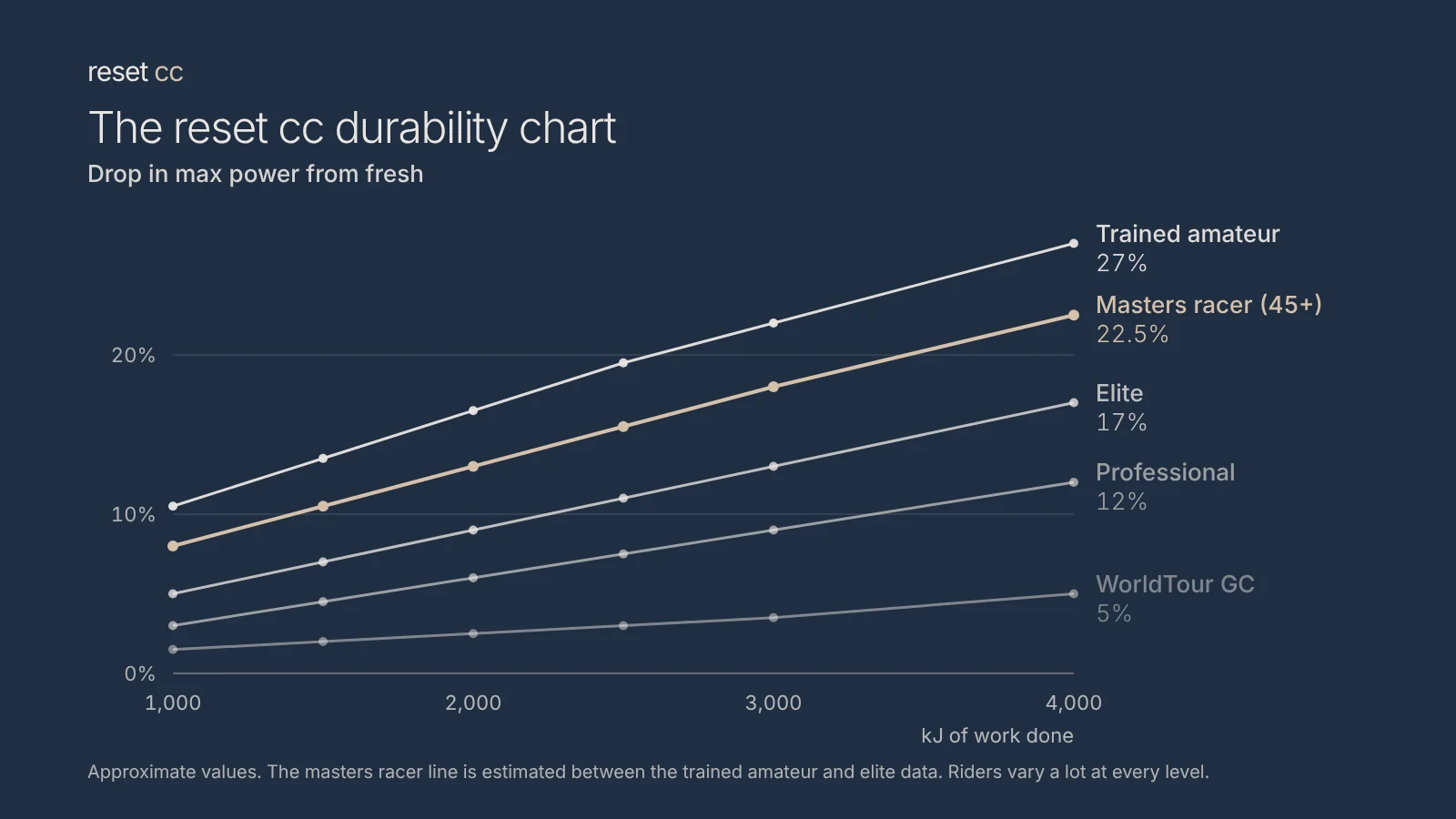
The higher the level, the smaller the fade. This is the reset cc durability chart: the approximate drop in maximum power from fresh, by how much work has been done.
Masters racers (45+) sit between trained amateurs and elite riders. The lines are split by racing level. There is no published masters study with kJ-based tests yet, so that line is our estimate. That is one reason I test my own riders.
The WorldTour line is GC riders, the most durable in the sport. Across all WorldTour riders, a large study found a drop of 4.7 to 8.8% after 45 kJ/kg, about 3,150 kJ for a 70 kg rider, depending on effort length (Mateo-March et al., 2022).
The test levels line up with the chart. Level 1 is 1,500 kJ and Level 2 is 2,500 kJ. Level 3, at 3,500 kJ, sits between the 3,000 and 4,000 kJ points.
The chart draws on published durability research, including home-based 5- and 20-minute tests on well-trained amateurs after 1,000 kJ (Barsumyan et al., 2025; Barsumyan et al., 2025) and 6 hours of simulated racing in national elite riders (Klaris et al., 2024). Individual riders vary a lot at every level, and kilojoules alone ignore intensity: work above threshold costs more than the same kJ ridden easy.
How to test your own durability
I test durability at three levels, depending on how developed a rider is. Each level is the same test: a fresh 5-minute max early in the ride, then a second 5-minute max once you have done a set amount of work.
Durability level
Second 5-minute max after
Level 1
1,500 kJ
Level 2
2,500 kJ
Level 3
3,500 kJ
Level 3 is for very fit amateurs.
The test workout
Warm up for 10 to 20 minutes.
Ride 5 minutes all out. Note your average power.
Ride steadily until your head unit shows your level’s total for the whole ride: 1,500, 2,500 or 3,500 kJ.
Ride 5 minutes all out again. Note your average power.
If you already know your fresh 5-minute max, you can skip the first effort and just do the second one late in the ride. You will still get a pretty accurate reading.
To see where you are, add a work (kJ) field to your head unit. To plan the ride, hours is roughly kJ divided by your average watts times 3.6: 2,500 kJ at 200 W average is about 3 h 30 min.
Fuel from the start the way you would in a race, and repeat the test in similar conditions so the numbers compare.
Reading your result
Your durability is the share of your fresh 5-minute power you can still produce after the work.
Durability (%) = fatigued 5-minute power ÷ fresh 5-minute power × 100
Quinn’s 473 W after 5,000 kJ against his 504 W best is 94%, a drop of 6%. A rider who does 300 W fresh and 270 W after 2,500 kJ keeps 90%, a 10% drop.
Durability check
How much of your fresh power do you keep?
Enter your fresh 5-minute max and the 5-minute max you did late in the ride. Pick the level you tested at to see where your drop sits on the reset cc durability chart.
Done after
Fresh power kept90%You kept 90% of your fresh power, a drop of 10% after 2,500 kJ.
Chart values are approximate. Riders vary a lot at every level.
Retest in similar conditions: the same route or trainer, similar fuelling and similar weather. As your durability improves, the drop shrinks.
Why it matters
Fondos are won and lost in the last hour. The final climb or the final selection comes after hours of work, so for fondo riders what you can still produce then matters more than your fresh FTP.
Winter is for building the engine. Get the long rides in.
Now and then, put the quality late in a long ride.
Practise race-day fuelling in training.
Watch how much you fade, as well as your FTP.
At reset cc we build durability into every rider’s season, around the events they are targeting. If you want help building yours for your target events, apply to join the team.
Coaching and membership · 2027 season
Build your durability with reset cc
Durability is built over a season. Your coach builds it into your week, around the events you are targeting, and updates the plan every week.
Team membership · 2027 season
Race the 2027 season with the team
Three levels, from one team camp to the whole season on the road to Worlds. Every level includes:
✓Your own reset cc coach
✓Strength and nutrition
✓Two calls a month
✓Your roadmap to Worlds
✓The Girona block
✓The full custom team kit
+Team Rider and Full Season add the team bike and more race camps