Filippo Ganna's diet: why amateur cyclists shouldn't copy it
In March 2026, after winning the opening time trial at Tirreno-Adriatico, Filippo Ganna said it makes him smile to see young riders weighing their food, because he won his first world time trial title “by eating Nutella, scrambled eggs and bacon”. He added that nutrition is important, but that staying relaxed about it matters more. That’s good advice for Filippo Ganna. For most amateur riders trying to change their body composition it’s the wrong lesson, and the reason is arithmetic. A professional burns so much energy that eating by feel rarely leaves them far off, and they’re rarely trying to lose weight. An amateur who wants to lose fat has to cut a large share of their food, and that’s too big a change to judge by feel.
Who Filippo Ganna is
Ganna is a two-time road world time trial champion (2020 and 2021), a seven-time track world champion, the Tokyo Olympic team pursuit champion and the current Hour Record holder, with 56.792 km in October 2022. He has won 10 Grand Tour stages, eight at the Giro and two at the Vuelta. He is listed at 193 cm and about 82 to 83 kg.
He came through Italian club teams, including Team Colpack, rode for Italy at the junior track worlds and won an elite world pursuit title at 19. He turned professional with UAE Team Emirates in 2017, has raced for Sky and INEOS since 2019, and joins Lidl-Trek for 2027. By the time he talks about food, he has spent more than a decade in a structured, fully supported environment, with team chefs, nutritionists and coaches around every race.
He also races a lot. He rode 68 road race days in 2022 and 69 in 2024, before you count training. A widely cited review put professionals at roughly 30,000 to 35,000 km a year of training and racing, and a small study of four professionals in one season found about 23,000 km. Treat either figure as a ballpark. A committed amateur riding 8 to 10 hours a week covers roughly 11,000 to 14,000 km a year (estimate), so professionals ride two to three times as much, or more.
The energy budget maths
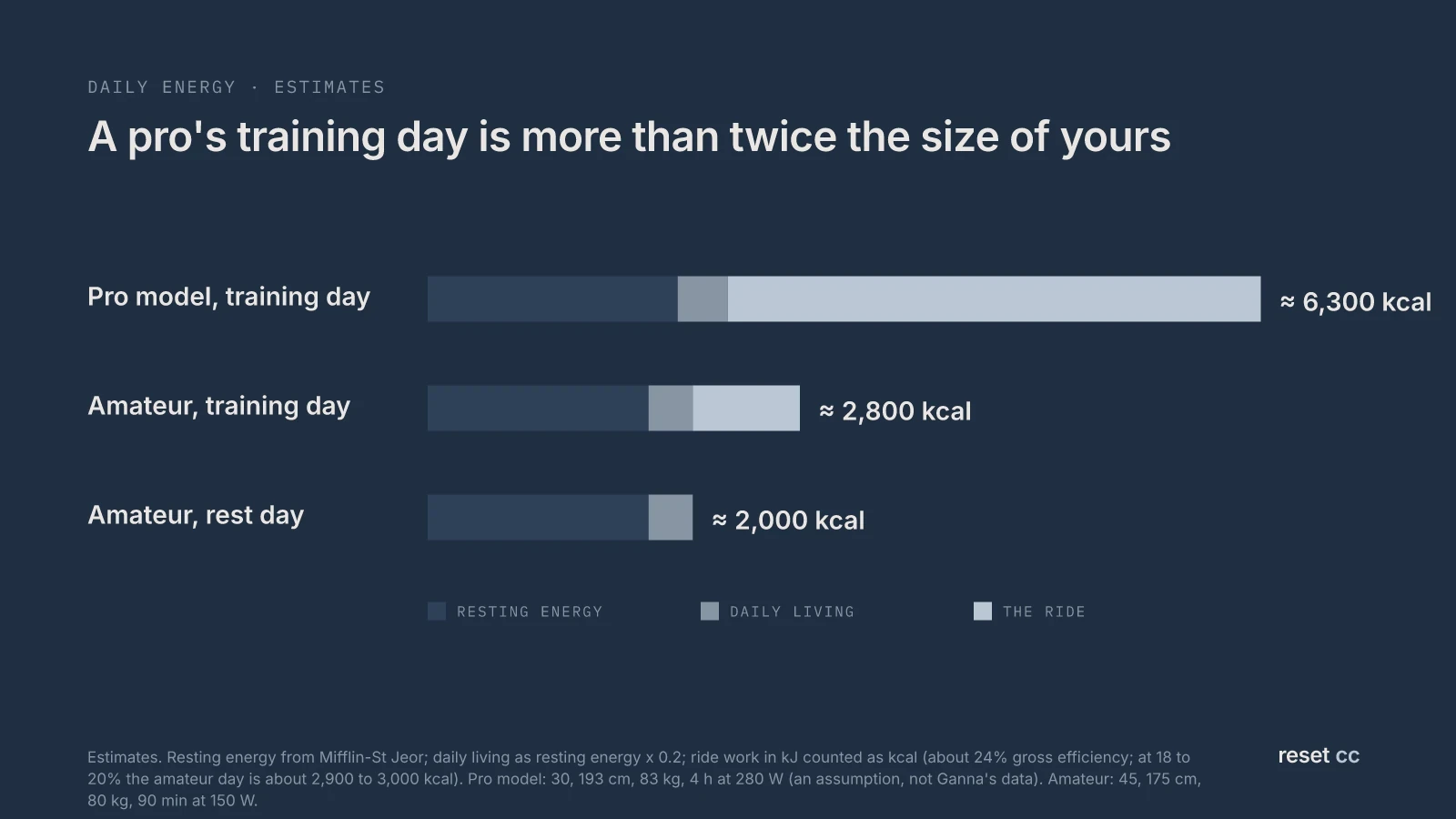
Here’s the comparison, worked through with standard equations. These are estimates, and the assumptions are in the footnote of the graphic.
Professional model
Amateur, 45, 80 kg, 175 cm
Resting energy (BMR)
About 1,890 kcal
About 1,670 kcal
Ride
4 h at 280 W, about 4,000 kcal
90 min at 150 W, about 800 kcal
Training day total
About 6,300 kcal
About 2,800 kcal (2,700 to 3,000)
Rest day total
About 2,300 kcal
About 2,000 kcal
The professional model is an assumption rather than Ganna’s own data. Counting ride work in kJ as kcal assumes a gross efficiency of about 24%, which fits hard riding. At an easy 150 W, efficiency is closer to 18 to 20%, which is why the amateur training day is shown as a range. Real Grand Tour riders measured with doubly labelled water, the gold-standard method, used roughly 6,900 to 7,700 kcal a day.
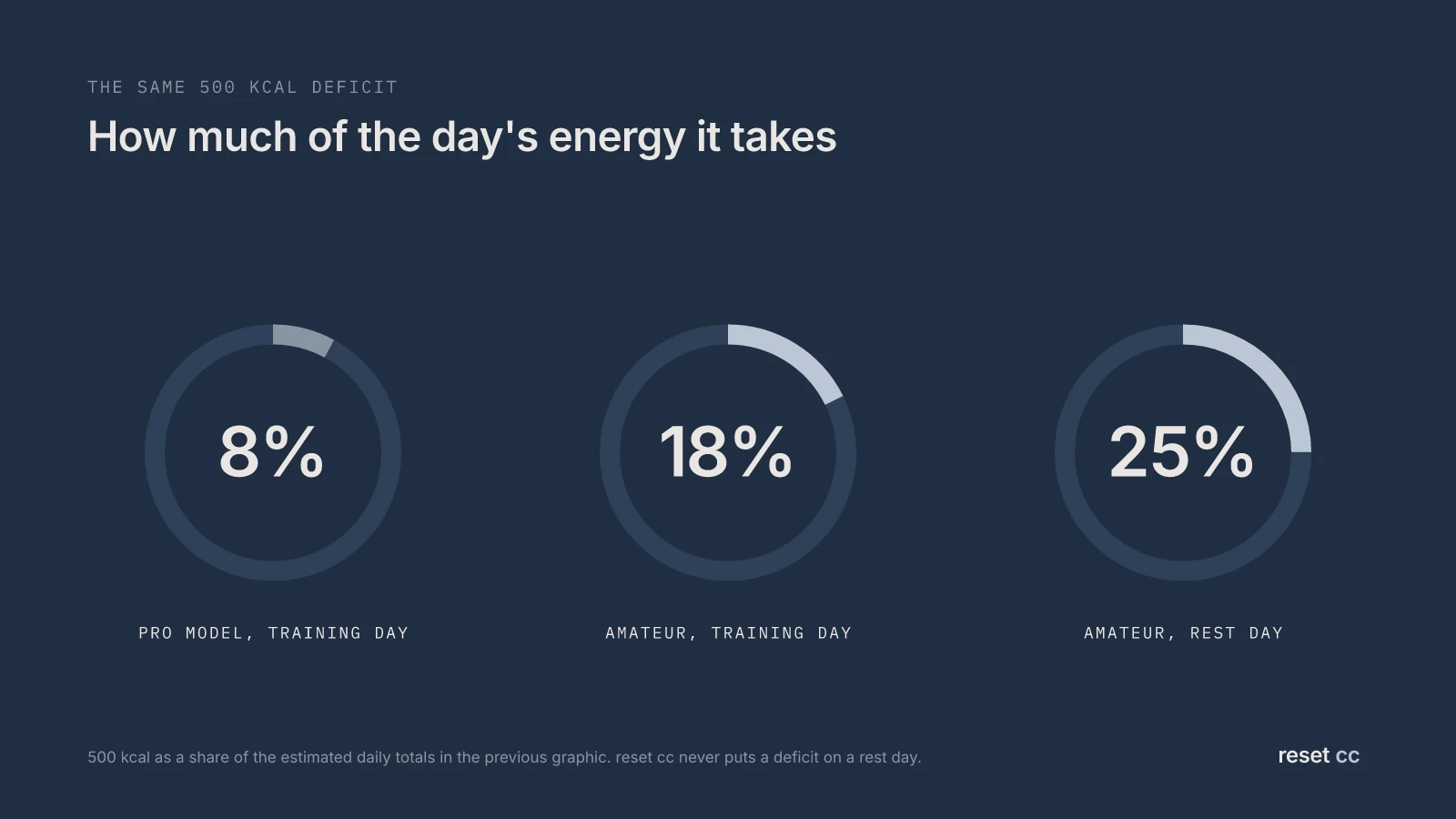
Now put the same 500 kcal deficit into each budget. For the professional model it means eating about 8% less than a training day burns. For the amateur it means eating about 18% less on a training day, and 25% less on a rest day. That’s a big cut to judge by feel, and a couple of untracked snacks can close it.
That’s the core of it. Ganna can eat intuitively because he burns a lot and is rarely trying to lose weight. An amateur with a job, a family and eight or ten hours a week on the bike has a much smaller budget, so any deficit is a large share of it. That’s also why we never put a deficit on a rest day, when the share would be largest.
Why intuition works better for professionals
A professional’s intuition about food has been trained by years of daily feedback inside a team that manages almost everything else: meals, travel, recovery and racing. Their bodies are different too.
Aerobic capacity. Professionals usually test above about 70 ml/kg/min of VO2max. Trained club riders more often sit in the 50s or low 60s.
Muscle. In small biopsy studies, national-class cyclists had about 23% more muscle capillaries than state-class cyclists with a similar VO2max, and elite endurance athletes had up to about 50% higher mitochondrial enzyme activity than well-trained ones. These come from small samples, evidence C.
Volume. All of that is built on tens of thousands of kilometres a year, year after year.
A 45-year-old who took up cycling five years ago is starting from a different place, with a different body, a smaller budget and far fewer hours of feedback. Advice from the professional world is useful, but it needs translating before it fits.
What amateur riders should do instead
Eat enough protein, every day
Sports nutrition guidance is 1.2 to 2.0 g of protein per kg of body weight a day (ACSM, 2016), and the ISSN recommends 1.4 to 2.0 g/kg. Older muscle seems to need more protein per meal to respond fully, so masters riders can aim for about 0.4 g/kg per meal. That evidence is strongest in people over 65, and less certain at 40 to 55. Our riders sit between 1.2 and 2 g/kg a day, depending on their goal and training.
Fuel the work on the bike
Under-fuelling training is one of the most common mistakes we see, especially in riders trying to lose weight. These are the carbohydrate targets we use on the bike:
Easy rides under 2 hours: 30 to 60 g an hour
Easy rides over 2 hours: 60 to 90 g an hour
Hard rides under 2 hours: about 70 to 90 g an hour
Hard rides over 2 hours: 90 to 120 g an hour
These are our coaching targets, outside planned low-carbohydrate rides. Consensus guidance tops out at 90 g an hour, and trials haven’t yet shown a performance benefit above that, so build up to the higher intakes gradually in training.
Track for a block, not forever
You don’t need to weigh your food all year. You do need to know what your portions are worth. In our coaching, the time to track closely is the off-season and preseason, when training load is lower and nothing is at stake if a week goes sideways. That timing is a coaching judgement, not a tested finding. After a block of tracking, most riders can estimate well enough to stop.
Treat body composition as a performance lever, carefully
Losing fat while holding power raises your power to weight, and that matters on every climb. Eating too little for your training is a different thing. Low energy availability is linked to poorer training, lower bone density and hormonal disruption, including in male cyclists. Good fat loss is slow, planned and kept away from your key training blocks.
There’s no single correct body-fat number either, and readings can shift by several points between methods. Track your own trend on one method rather than chasing a figure. If you have a history of disordered eating, don’t run a weight loss plan without medical support.
Where Ganna is right
Being relaxed about food matters. Obsessive tracking, guilt about every meal and rigid rules that you can’t keep up all make riders worse. The point of structure is to build the knowledge and habits that let you stop thinking about it later. Ganna got there through years of professional support. Most amateurs get there through a few well-planned blocks.
12-week plan / start any Monday
The Reset Off-Season
This is how I sequence the off-season for the athletes I coach, written so you can ride it on your own. It takes you from the end of the off-season through the preseason, with every session laid out.
Riding hours per week, Standard tier. Strength adds about 2 h.
Foundation and torque
Weeks 1 to 4
On the bike
Most riding in zone 1, with zone 2 ridden as a session of its own
Seated torque efforts at 50 to 60 rpm, from 4 by 6 min to 5 by 8 min
First tempo in week 3, FTP test in week 1
In the gym
Two weeks of technique, then single-leg main lifts at 4 to 6 reps.
Every main lift is single-leg, with no barbell and no load across your back.
Pick your tier
All three ride the same key sessions.
Riding
5 h 30 to 11 h a week
Long ride
Up to 4 h
Sessions
57 rides and 20 strength sessions
Choose it ifYou ride 8 to 10 hours a week in season.
What you get
The GuideThe reasoning behind every session, the zone model, the 18-exercise strength program and the fuelling page.
Your calendarEvery session by week and day for your tier, as a PDF and a spreadsheet.
Workout filesEvery ride in .zwo, .mrc and .fit, for Zwift, TrainerRoad, TrainingPeaks, Intervals.icu, Garmin and Rouvy.
The calculatorYour carbohydrate, protein, fat and energy for every day of the 12 weeks, set for your goal.
The courseA lesson for each part of the plan, with strength log sheets for every phase.
You need a power meter or smart trainer, and a gym with heavy dumbbells or kettlebells. A home version of the strength program is included.
In a March 2026 interview after the opening time trial of Tirreno-Adriatico, Ganna said that seeing young riders weigh their food makes him smile, because he won his first world time trial title eating Nutella, scrambled eggs and bacon. He said nutrition is important, and that being mentally relaxed about it matters more.
How many calories do professional cyclists burn?
Grand Tour riders measured with doubly labelled water used roughly 6,900 to 7,700 kcal a day. A long training day is estimated at over 6,000 kcal.
Should amateur cyclists count calories?
For a block, yes, especially in the off-season if you want to change body composition. The goal is to learn what your portions are worth, so you can stop tracking closely afterwards.
How much protein do masters cyclists need?
Guidance ranges from 1.2 to 2.0 g/kg a day (ACSM) to 1.4 to 2.0 g/kg (ISSN), with around 0.4 g/kg per meal for older riders. Our riders sit between 1.2 and 2 g/kg depending on their goal.
Coaching and membership · 2027 season
A plan built for your life, not a pro's
Every reset cc rider gets training, strength and nutrition written for their own hours, goals and energy budget.
Team membership · 2027 season
Race the 2027 season with the team
Three levels, from one team camp to the whole season on the road to Worlds. Every level includes:
✓Your own reset cc coach
✓Strength and nutrition
✓Two calls a month
✓Your roadmap to Worlds
✓The Girona block
✓The full custom team kit
+Team Rider and Full Season add the team bike and more race camps
Zack Morris is the founder of reset cc. Silver medalist, M35-39 time trial, 2026 UCI Gran Fondo World Championships. National champion, elite and masters. Built and ran Team EF Coaching for five years.